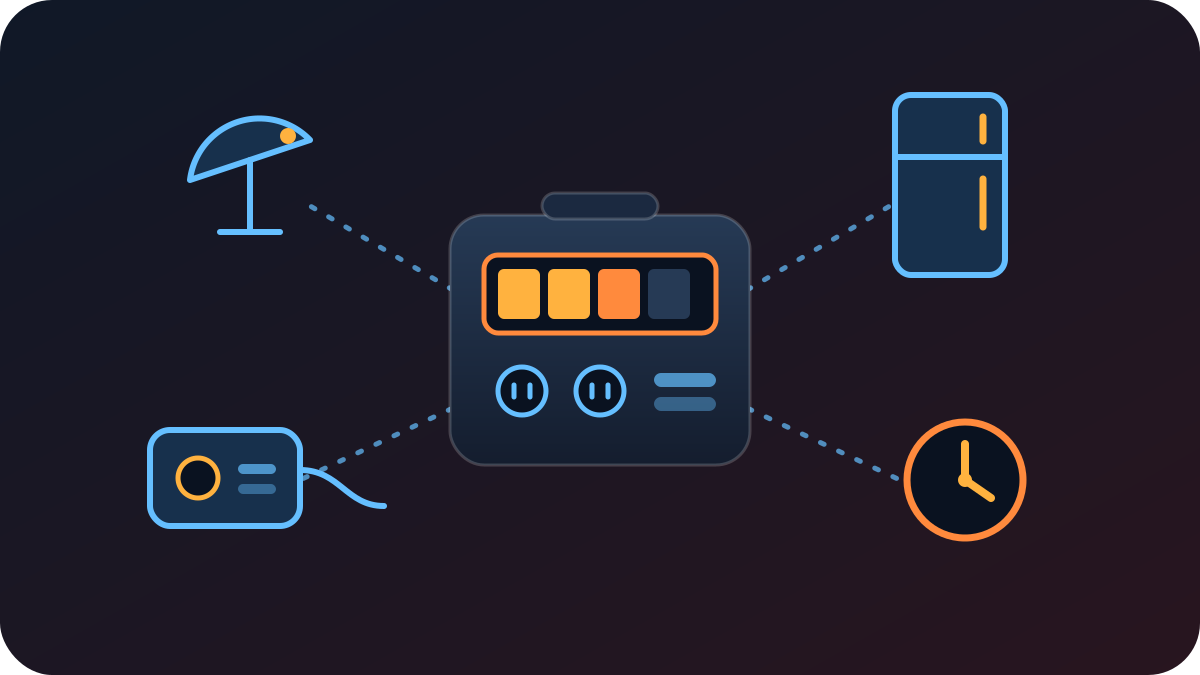
Watts and watt-hours: which number answers which question?
A portable power station has two main ratings. They sound alike, but they answer different questions.
Watts (W) measure power at one moment. A station's continuous output in watts is how much it can supply at once. This number decides what the station can run.
Watt-hours (Wh) measure stored energy. A station's battery capacity in watt-hours is how much energy it holds. This number decides how long it can run something.
station watts > device wattsbattery Wh ÷ device watts = hoursA station can pass one test and fail the other. A small unit may have plenty of output for a laptop but a battery that lasts only a few hours. A large unit may hold a lot of energy but still shut off if a big motor asks for more power than it can give at once.
You need both numbers for the station, and one number for the device: how many watts it draws. The next sections show where to find that.
How much power does your device draw?
The draw is the starting point for all sizing. Makers publish it in different ways. Some give watts. Some give amps. Some give only the energy used in a year. Here are figures the makers themselves publish for four kinds of device.
| Device | What the maker states | In watts |
|---|---|---|
| Starlink Standard kit | Average power consumption | 75 to 100 W |
| ResMed AirSense 11 (CPAP) | Typical and peak power consumption | 56.1 W typical, 73.2 W peak |
| Frigidaire FFTR1835V refrigerator | 410 kWh of energy a year | 46.8 W on average |
| LG LHTNS2403S refrigerator | 417 kWh of energy a year | 47.6 W on average |
| Whirlpool WRT311FZD refrigerator | 436 kWh of energy a year | 49.8 W on average |
| N80MSN gas furnace, smallest size | Maximum unit amps of 5.9 A at 115 V | 679 W at most |
| N80MSN gas furnace, largest size | Maximum unit amps of 14.4 A at 115 V | 1,656 W at most |
Notice how different the forms are. The dish and the CPAP machine come with a figure in watts. The refrigerators come with a yearly energy figure. The furnace comes with amps. The sections below show how to turn each form into the watts you need.
These are examples, not a chart for every model. A different dish, CPAP machine, refrigerator or furnace will have its own figures. Always use the numbers for the device you own.
Where do you find the draw of your own device?
The best source is the device itself. Most appliances carry a rating plate, also called a serial tag or model tag. Whirlpool says the model and serial tag lists amps, volts, wattage, or a mix of the three. GE Appliances says the rating plate on the appliance has the running amperage or wattage.
If the plate gives watts, you are done. If it gives amps, multiply by the voltage.
Take the furnace in the table above. Its smallest size lists 5.9 A at 115 V. 5.9 × 115 = 678.5, so about 679 W. Its largest size lists 14.4 A. 14.4 × 115 = 1,656 W.
A figure worked out from the plate is usually a ceiling. It is the most the device is rated to draw, and the real draw is often lower. That makes it a safe number for checking output, and a cautious one for run time.
The user manual is the next place to look. So is the yellow EnergyGuide label that comes with large appliances in the United States. That label gives the energy the appliance uses in a year, which the next section turns into watts.
Average draw, running draw, rated load: why do they differ?
Some devices draw about the same power the whole time they are on. Others cycle. A refrigerator is the common example: its compressor runs for a while, then rests. That gives a refrigerator three different power figures, and mixing them up is the most common sizing mistake.
Average draw. This is the yearly energy spread evenly over every hour of the year. It is the right figure for run time, because the battery only supplies energy while the compressor runs.
The Whirlpool WRT311FZD is listed at 436 kWh a year. 436 × 1,000 ÷ 8,760 = 49.8 W on average. The same label works out to 436 ÷ 365 = 1.19 kWh a day.
Running draw. This is what the appliance pulls while the compressor is on. It is higher than the average, because the average includes the rest periods. The labels above do not state it.
Rated load. This is the most the appliance is rated to draw, as printed on its plate or spec sheet. One older Frigidaire refrigerator, the FFRU17B2QW, lists 5 A at 115 V and a connected load of 0.6 kW. The amps and the load agree: 5 × 115 = 575 W, which rounds to 0.6 kW.
So one refrigerator can average about 50 W across a day and still be rated for several hundred watts. Use the average for run time. Use the rated load, and the start-up surge in the next section, for output.
Whirlpool's own guide for sizing a generator goes further and allows 1,000 running watts for a refrigerator or freezer. Whirlpool marks those figures as estimates to use only as a rough guide. A figure like that is a safe allowance for output, not a measure of what the appliance uses.
How much extra power does a motor need to start?
Devices with motors or compressors need a short burst of extra power when they start. A power station has to cover that burst, or the device will not start.
Two appliance makers give rules of thumb for it. Whirlpool says a motor may need two to three times its running amps to start, and recommends doubling the running wattage for refrigeration. GE Appliances says start-up amps and watts are usually 3 times the running amps or watts.
Here is how those rules play out. With Whirlpool's allowance of 1,000 running watts for a refrigerator, doubling gives 1,000 × 2 = 2,000 W to start. As an illustration of GE's rule, an appliance that runs at 600 W would need about 600 × 3 = 1,800 W for a moment.
These are rules of thumb, not measurements of your appliance. The makers' documents used for this guide do not give a start-up figure for any single model. Treat the rules as a way to leave enough room, and choose a station whose surge or peak rating is above the result.
Power stations list this ability under names such as surge, peak or power lifting. It is a short burst the station can supply, separate from its continuous output. Compare surge with start-up, and continuous output with running draw. Do not mix the two.
Devices without motors, such as a dish, a router, a laptop or a light, have little or no start-up surge. For those, the running draw is the number that matters.
Is the power station's output enough?
Now compare the station with the device. Three checks cover it.
- Continuous output is above the running draw. If the device is rated at 600 W, the station needs more than 600 W of continuous output.
- Surge rating is above the start-up need. For a motor or compressor, use the maker's rule of thumb from the section above.
- The outlet matches. Check that the station has the kind of outlet the device plugs into, and enough of them.
Leave some room rather than sizing to the exact watt. A station working near its limit has nothing spare for a second device or a brief peak.
Low-power devices pass this check easily. The Starlink Standard kit draws 75 to 100 W on average and the AirSense 11 peaks at 73.2 W. Even a small station supplies more than that. For such devices, output is not the limit. Battery size is.
How long will the battery last?
Run time is stored energy divided by the draw.
The examples below use a made-up station with a 1,000 Wh battery. It is not a real product. The device figures are the makers' own.
| Device | Draw | The math | Most hours |
|---|---|---|---|
| Starlink Standard kit, high end | 100 W | 1,000 ÷ 100 = 10.0 | 10.0 |
| Starlink Standard kit, low end | 75 W | 1,000 ÷ 75 = 13.3 | 13.3 |
| AirSense 11, typical | 56.1 W | 1,000 ÷ 56.1 = 17.8 | 17.8 |
| AirSense 11, peak | 73.2 W | 1,000 ÷ 73.2 = 13.7 | 13.7 |
| Whirlpool WRT311FZD, average | 49.8 W | 1,000 ÷ 49.8 = 20.1 | 20.1 |
| N80MSN furnace, smallest size, running without a break | 679 W | 1,000 ÷ 679 = 1.5 | 1.5 |
You can also work the other way. Start with the hours you need and find the battery size.
Example B (illustrative): one night of CPAP use at the AirSense 11's typical draw, for 8 hours. 56.1 × 8 = 448.8 Wh before losses.
Example C (illustrative): a dish left on for a full day at the high end of its average. 100 × 24 = 2,400 Wh before losses.
The furnace line needs a note. A furnace does not run without a break. It cycles on and off with the thermostat, so the battery lasts longer on the clock than 1.5 hours. How much longer depends on the weather and the house, and the makers' documents give no figure for it. The line shows only how long the stored energy lasts while the furnace is actually running at its rated maximum.
Why is real run time shorter than the math says?
Dividing watt-hours by watts gives a ceiling. Three things bring the real number down.
- Usable capacity. Many stations hold back part of the battery to protect the cells. A manual may state this as depth of discharge.
- Inverter losses. Turning the battery's DC power into AC power for an outlet wastes some energy as heat. A manual may state this as inverter efficiency.
- The station's own use. The screen, the fans and the electronics use power the whole time the station is on.
Some makers publish all three figures. When they do, you can work out a closer estimate.
Example D (illustrative): a made-up 1,000 Wh station whose manual lists 90% depth of discharge, 85% inverter efficiency and 10 W of its own use, running a 100 W device. Usable energy is 1,000 × 0.90 × 0.85 = 765 Wh. The total draw is 100 + 10 = 110 W. Run time is 765 ÷ 110 = 7.0 hours, against 10.0 hours from the simple math.
In this example the real figure is about seven tenths of the ceiling. Your station may do better or worse. If its manual lists these figures, use them. If it does not, treat the simple math as the most you could get and plan for less.
One way to cut the losses is to skip the inverter. Some devices can run from a DC outlet. The AirSense 11's power supply puts out 24 V DC, and ResMed offers a DC/DC converter for it as an accessory. Power that goes from battery to device as DC is not converted to AC and back.
What if you run several things at once?
Add the draws together. Then do both checks again with the total.
Example E (illustrative mix of real devices): a Starlink Standard kit at 100 W, an AirSense 11 at 56.1 W and a Whirlpool WRT311FZD at its 49.8 W average. 100 + 56.1 + 49.8 = 205.9 W. On the made-up 1,000 Wh station, 1,000 ÷ 205.9 = 4.9 hours before losses.
For output, add the running draws of everything that will be on at the same time. Then add the largest single start-up surge. Motors rarely start at the same instant, so you do not need to add every surge.
Remember that the refrigerator's 49.8 W is an average. While its compressor is on, the total draw is higher than 205.9 W, and the station must supply that. The average is right for hours. The rated load is right for output.
What about devices wired into the house, like a gas furnace?
A gas furnace burns gas for heat, but it needs electricity for its blower, its controls and its igniter. That is why a furnace stops in a power cut.
The electrical need is modest next to an electric heater. The N80MSN series lists maximum unit amps from 5.9 A to 14.4 A at 115 V across its sizes, and an operating range of 104 to 127 V. Goodman's GR9S80 series lists a 115 V, 60 Hz, single-phase supply and a minimum circuit ampacity of 7.7 A to 14.3 A.
The harder part is the connection. Both makers set rules for the wiring.
- The N80MSN manual says proper polarity must be kept for the 115 V wiring, and that the furnace will not operate if polarity is wrong.
- It also says the furnace control must be grounded, or the control will lock out.
- Goodman says the wiring to the unit must be polarized and grounded.
- Both call for a separate fused branch circuit for the furnace.
A furnace is normally wired into the house, not plugged into an outlet. Do not rewire it yourself to reach a power station. Ask a licensed electrician how to connect backup power safely and within your local code.
Neither maker's documents state how many watts the furnace uses in normal running, or how much it needs to start. The amps on the rating plate are a ceiling. For a plan you can rely on, read the plate on your own furnace and have the electrician measure the real draw.
How fast can solar refill the battery?
A station that runs something all day needs a way to refill. Each station lists a maximum solar input in watts. That number caps how fast panels can charge it, no matter how many panels you connect.
Example F (illustrative): a 1,000 Wh station that accepts up to 200 W of solar. 1,000 ÷ 200 = 5.0 hours at the very best.
That is a best case with the panels making their full rated power the whole time. Real panels make less than their rating for most of the day. Sun angle, clouds, heat and shade all cut the output, so a real refill takes longer.
For an all-day load, compare energy in with energy out. In Example C the dish uses 2,400 Wh in a day. The panels would need to put back at least that much in the hours of good sun, on top of running the dish while they do it.
Check the station's solar input limits before buying panels. They include a voltage range and a current limit as well as watts, and the connector has to match. The solar recharge estimator and the compatibility checker can help with both.
Does cold weather change the plan?
Yes. Batteries have temperature limits, and the limit for charging is usually tighter than the limit for running.
Many lithium iron phosphate stations are rated not to charge below freezing, while still being rated to supply power at lower temperatures. The exact limits are on each product's page and in its manual.
The device may be tougher than the battery. The Starlink Standard kit's antenna is rated to work from -30 °C to 50 °C. The AirSense 11 is rated for 5 °C to 35 °C, so it belongs indoors.
For winter use, keep the station somewhere warm enough to charge. Plan the solar refill for a time and place where the battery is inside its charging range.
What sizes are on sale right now?
The table below is live. It is re-checked whenever this page loads. It lists the power stations with the most watt-hours per dollar right now, with the battery size and continuous output of each. The last column is the simple run-time math for a 100 W draw: battery size divided by 100, before losses.
| Product | Battery | Continuous output | Best current price | Most hours at 100 W |
|---|---|---|---|---|
| BLUETTI Elite 400 | 3,840 Wh | 2,600 W | $1,399.00 | 38.4 |
| BLUETTI AC180 Solar | 1,152 Wh | 1,800 W | $449.00 | 11.5 |
| BLUETTI Elite 300 | 3,014 Wh | 2,400 W | $1,199.00 | 30.1 |
| BLUETTI Elite 100 mini | 1,004.8 Wh | 700 W | $429.00 | 10.0 |
| BLUETTI Elite 200 V2 | 2,073.6 Wh | 2,600 W | $899.00 | 20.7 |
| EcoFlow DELTA 3 Ultra Series | 3,072 Wh | 3,600 W | $1,349.00 | 30.7 |
| BLUETTI Elite 100 V2 | 1,024 Wh | 1,800 W | $489.00 | 10.2 |
| EcoFlow DELTA 2 Max | 2,048 Wh | 2,400 W | $1,029.00 | 20.5 |
Use the table to see what a given battery size costs today. Then apply your own draw in place of 100 W. You can browse every tracked unit on the power stations page.
A sizing checklist.
- List what you will run. Write down each device and whether it has a motor or compressor.
- Find each draw. Use the rating plate, the manual or the EnergyGuide label for your own model.
- Convert to watts. Volts × amps for a plate in amps. Yearly kWh × 1,000 ÷ 8,760 for an average.
- Keep the three figures apart. Average for hours, rated load for output, start-up for surge.
- Add what runs together. Total the running draws, then add the largest start-up surge.
- Check continuous output. It must be above the total running draw, with room to spare.
- Check surge. It must be above the start-up need.
- Decide the hours. How long must it run before you can recharge?
- Work out the battery. Watts × hours, then add a margin for losses.
- Plan the refill. Wall, car or solar, and how long each takes.
- Check the conditions. Temperature limits, weight if you carry it, and the outlets you need.
- Compare prices last. Once the size is right, compare watt-hours per dollar among stations that fit.
Common mistakes to avoid.
- Reading watts as watt-hours. One is power, the other is stored energy.
- Sizing output from an average. A refrigerator that averages 50 W draws far more while its compressor runs.
- Sizing run time from a rated load. The plate figure is a ceiling, so it makes the battery look too small.
- Forgetting the start-up surge. A motor that cannot start will not run at all.
- Mixing surge with continuous output. Compare surge with start-up and continuous with running.
- Treating the simple math as a promise. It is the most the stored energy allows, before losses.
- Using someone else's device figure. Models differ. Use your own label.
- Counting on rated panel watts all day. Real solar output is lower for most of the day.
- Charging a cold battery. Check the charging temperature limit first.
- Rewiring a hard-wired appliance yourself. Use a licensed electrician.
Related tools and pages.
- Portable power stations
- Power stations for a Starlink dish: how long each one runs it
- Solar recharge estimator
- Compatibility checker
- Battery lifetime value tool
- How to compare solar equipment prices
- Solar panels
Power station sizing FAQ.
What size power station do I need?
One whose continuous output is above your total running draw, whose surge rating covers the largest start-up, and whose battery in watt-hours is at least your draw in watts times the hours you need, plus a margin for losses.
What is the difference between watts and watt-hours?
Watts are power at one moment and decide what the station can run. Watt-hours are stored energy and decide how long it runs.
How long will a 1,000 Wh power station run a 100 W device?
At most 10 hours, since 1,000 divided by 100 is 10. Real run time is shorter because of usable capacity, inverter losses and the station's own use.
Why does a refrigerator need a bigger station than its average draw suggests?
Because the average includes the time the compressor is off. While it runs it draws more, and it needs an extra burst to start. Size the output for the rated load and the start-up, and the battery for the average.
Can a portable power station run a gas furnace?
The furnace's electrical need can be within reach of a larger station, but a furnace is wired into the house and its maker requires correct polarity and grounding. Have a licensed electrician set up the connection.
The figures for named devices come from each maker's own published documents: specification sheets, user guides, installation manuals, EnergyGuide labels and support pages. Solar Gear Scout has not tested these devices or any power station. Figures worked out on this page, such as average watts from yearly energy, use only the formulas shown.
Examples marked illustrative use made-up stations and round numbers to show the math. They are not real products. The only current product data on this page is in the live table, which is filled in from Solar Gear Scout's price data each time the page loads. Confirm prices, stock and specifications on the store's and maker's pages before you buy.