What does each type of inverter do?
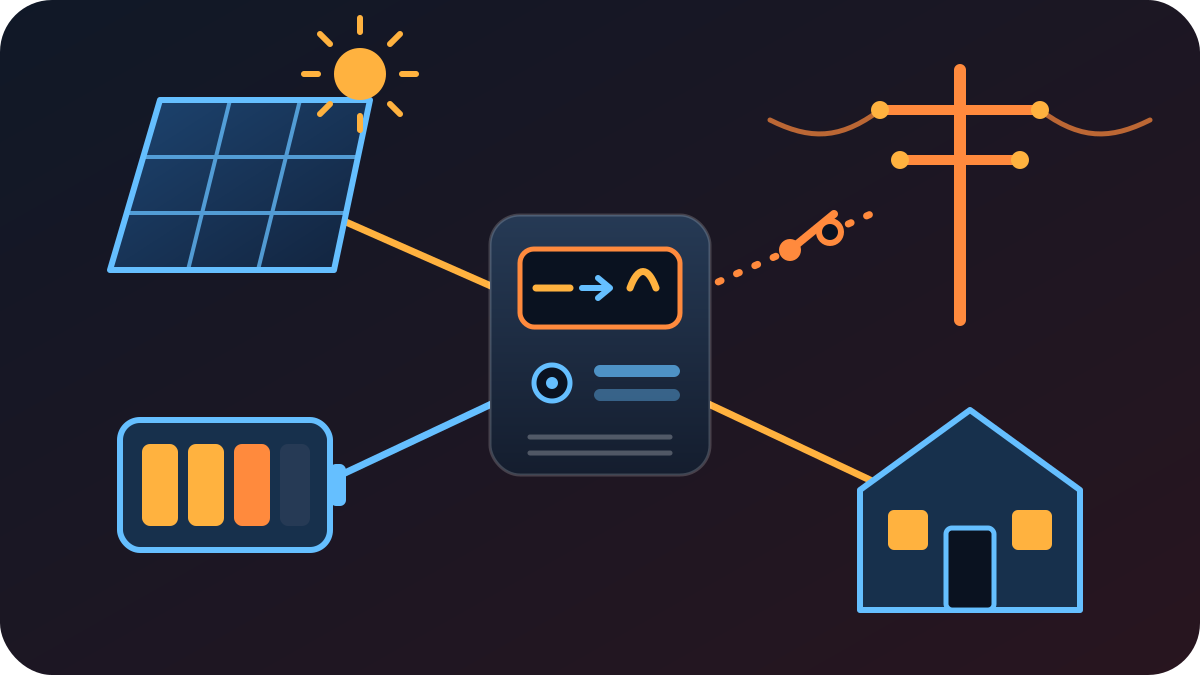
A battery stores direct current, or DC. A house runs on alternating current, or AC. An inverter turns the first into the second. Most of the units in this guide are inverter/chargers, which means they can also run the other way and charge the battery from an AC source.
The two types differ in how they deal with the utility grid.
An off-grid inverter runs a home from solar panels and a battery bank without a utility connection. Many have an AC input as well. That input can take grid or generator power to charge the batteries and carry the loads, but the inverter does not send power back to the grid.
A hybrid inverter works with solar panels, a battery bank and the utility grid together, and it can also run off the grid. Some makers say their hybrid inverters can sell power back to the grid, where the utility allows it.
A plain battery inverter is a third kind. It only turns battery power into AC power and has no solar input of its own. It is common in vans, trailers and small cabins. It is neither off-grid nor hybrid in the sense used here, so it is left out of the live table further down.
| Question | Off-grid inverter | Hybrid inverter |
|---|---|---|
| Runs loads from a battery | Yes | Yes |
| Works with no utility service | Yes | Yes |
| Takes grid power in | On models with an AC input | Yes |
| Sends power back to the grid | No | On models whose maker says so, where the utility allows it |
| Certified to connect to the grid | Not needed with no grid connection | Look for UL 1741 on the spec sheet |
The names are not always printed on the box. Look for how the maker describes the unit on its spec sheet. Solar Gear Scout's inverter pages state the type only when the maker's own document does.
Which one do you need?
Start with one question. Will the system ever send power to the utility grid?
- A cabin, a barn or a home with no utility service. An off-grid inverter fits. There is no grid to work with.
- A home with utility service, where you want to sell or send extra solar back. You need a hybrid inverter that is certified for grid connection, and your utility has to approve the system first.
- A home with utility service, where you only want backup power. Either type can do it. An off-grid inverter with an AC input can use the grid to charge its batteries and carry loads. A hybrid adds the choice to send power back later.
- A system that may grow. A hybrid keeps more doors open, since it can run off the grid today and connect to it later.
The type narrows the list. The rest of this guide is about the numbers that decide whether a given unit can do the work, and they apply to both types.
How much continuous output do you need?
Continuous output is the power an inverter can supply for as long as you like. It is given in watts, and it has to be higher than everything you run at the same time.
Example A (illustrative): a made-up home runs a well pump at 1,500 W, a refrigerator at 600 W, a microwave at 1,200 W and lights at 300 W. If all four are on together, the total is 1,500 + 600 + 1,200 + 300 = 3,600 W. An inverter for that home needs more than 3,600 W of continuous output, with some room to spare.
Watts and VA. Some makers give the rating in volt-amps, or VA, and not in watts. VA is volts times amps. The watts an inverter delivers are never more than its VA figure, and for many home loads the two are close. When a maker gives the continuous rating only in VA, Solar Gear Scout counts it as watts and shows the VA figure next to it, so you can see which one the maker gave.
Output from the battery alone. Some hybrid inverters list two continuous figures. One is the output with solar or the grid helping. The other is the output from the battery alone, and it can be lower. Picture a made-up hybrid that lists 12,000 W with help and 10,000 W from the battery alone. In a power cut at night, 10,000 W is the figure that counts.
Voltage and phase. Check the AC output as well. A split-phase inverter supplies both 120 V and 240 V, as a house panel does. A single-phase 120 V inverter cannot run a 240 V load by itself. A three-phase unit is made for three-phase service, which is found in commercial buildings more than in homes.
What is surge output, and how long does it last?
Surge output is a short burst above the continuous figure. It is also called peak output. It exists because some loads, mostly motors, need extra power for a moment as they start.
A surge rating has two parts: how many watts, and for how long. The second part matters as much as the first. The inverter spec sheets and manuals on file at Solar Gear Scout list peaks that last from 0.5 seconds to 300 seconds, which is 300 ÷ 60 = 5 minutes. A half-second peak is there to get a motor started, while a five-minute peak can carry a longer overload.
Example B (illustrative): a made-up inverter lists 6,000 W continuous and a peak of 12,000 W for 5 seconds. Its peak is 12,000 ÷ 6,000 = 2 times its continuous output. It can cover a 9,000 W start that is over in a second. It cannot run a 9,000 W load.
Compare like with like. Hold continuous output against the running watts of your loads, and surge output against the starting need. A big surge figure does not make up for a small continuous one.
Can it start a well pump or an air conditioner?
Motors draw a burst of current as they start. Makers describe that burst with a figure called locked rotor amps, or LRA. A pump or an air conditioner has an LRA on its nameplate. Some inverter spec sheets list an LRA too, which is the largest motor start the inverter is rated to handle.
The check is a simple one. The LRA on the motor's nameplate should be no higher than the LRA on the inverter's spec sheet. The inverter sheets on file that state an LRA list from 95 A to 195 A.
Example C (illustrative): a made-up inverter lists an LRA of 150 A. A made-up air conditioner with 110 A on its nameplate is within that rating. One with 170 A on its nameplate is not.
When a spec sheet gives no LRA, use the surge watts and how long they last. Then ask the maker or your installer about the motor you plan to run. Do not guess with a well pump, because a pump that cannot start leaves you with no water.
What battery voltage does it need?
Every inverter is built for one battery voltage, and the battery bank has to match it. The common classes are 12 V, 24 V and 48 V. The inverters on file here run on 12 V and 48 V banks, and one three-phase unit runs on a 300 V battery.
Bigger inverters use higher battery voltage for a reason. Power is volts times amps, so the same power at a lower voltage needs more current, and more current needs thicker cable.
Example D (illustrative): a 3,000 W load on a 12 V battery draws 3,000 ÷ 12 = 250 A before losses. The same load on a 48 V battery draws 3,000 ÷ 48 = 62.5 A. That is a quarter of the current.
Three more battery lines on the spec sheet are worth reading.
- Battery voltage range. The battery must stay inside it while it charges and discharges.
- Battery types. Many makers list both lead-acid and lithium. Use a type the maker lists.
- Charge and discharge current. The most current the inverter puts into the battery and draws from it. The discharge figure limits the output from the battery alone. On a made-up 48 V unit that draws up to 250 A, the most the battery can feed in is 250 × 48 = 12,000 W before losses.
How much solar can you connect?
Many off-grid and hybrid inverters have solar inputs built in. Some inverter/chargers have none, and their panels charge the battery through a separate charge controller. Check which kind you are looking at.
When the solar input is built in, the spec sheet lists these limits.
- Maximum solar array. The most panel watts the maker recommends connecting.
- Usable solar power. The most solar watts the inverter can use at one time. It can be lower than the array figure.
- Number of MPPT inputs. Each input tracks its own string of panels, so strings that face different ways can each be tracked on their own.
- Maximum input voltage. Every string must stay below it, even on a cold morning.
- MPPT voltage range. The range where the inverter tracks the panels' best power. Size each string to run inside it.
The voltage rules are the same ones a portable power station follows, and the guide to solar input limits works through them. The difference is scale. A home inverter's strings can run at several hundred volts, which is dangerous to handle. String design and wiring belong to a licensed electrician or solar installer.
Can you connect more than one unit?
Often, yes. Many makers let you wire several of the same inverter in parallel so that their outputs add up. The spec sheet gives the most units allowed. The sheets on file that give a number list from 8 to 16 units.
Example E (illustrative): two made-up 6,000 W inverters in parallel supply up to 6,000 × 2 = 12,000 W of continuous output.
This matters when you plan to grow. You can start with one unit and add a second when the loads or the budget allow. Units in parallel must be the same model unless the maker says otherwise, and each added unit needs its own wiring and protection. That is installer work.
Can it be installed outdoors?
That depends on the enclosure rating. It is printed on the spec sheet as a NEMA type, an IP code, or both.
| Rating | What it means | Where it belongs |
|---|---|---|
| NEMA 4X | Made to stand up to rain, hose-directed water and corrosion. | Outdoors or indoors |
| NEMA 3R, IP65 or higher | An outdoor rating that keeps out rain and dust. | Outdoors or indoors |
| IP21 or NEMA 1 | Little protection against water. | Indoors |
| IP20 | No protection against water. | Indoors |
An indoor unit needs a dry room with space around it for air to move. An outdoor rating does not mean any spot will do. Read the maker's manual for clearances, shade and the operating temperature range, which is also on the spec sheet.
Can you connect a generator?
Many inverter/chargers can. On those models the AC input takes generator power, which can charge the batteries and carry your loads at the same time. Look for a generator input on the spec sheet.
A generator matters most off the grid. After several dark days the battery runs low and the panels cannot catch up, and a generator fills the gap. In a home with utility service it is a second backup behind the battery.
The generator has to be large enough to do both jobs at once. The manual gives the settings for it, and an electrician should make the connection.
How efficient is it, and how fast does it switch over?
CEC weighted efficiency. No inverter turns all of its DC power into AC power. Some is lost as heat. CEC weighted efficiency averages an inverter's efficiency across typical power levels, so it is the usual figure for comparing one inverter with another. The sheets on file that state it list from 91% to 97%.
Example F (illustrative): send 10 kWh through an inverter at 97% and 10 × 0.97 = 9.7 kWh comes out. At 91% the figure is 10 × 0.91 = 9.1 kWh. The gap is small in one day and adds up over years.
Transfer time. This is how long the inverter takes to switch to battery power when the grid or the generator drops out. It is given in milliseconds. The sheets on file that state it list from 4 ms to 20 ms. A shorter time is kinder to computers and other devices that do not like a gap in power.
What do UL 1741 and rapid shutdown mean?
UL 1741 is the US safety standard for inverters that connect to the grid. If you plan to connect to the grid, look for it on the spec sheet. Its SA and SB supplements cover the grid-support functions that many utilities require.
A certification is not permission. Your utility decides whether a system may connect and whether it may send power back. Ask the utility what it requires before you buy, because the answer can rule a model in or out.
Rapid shutdown is a safety function for rooftop solar. It lets the panels on a roof be shut down quickly in an emergency. The electrical code calls for it in section NEC 690.12. Some inverters have it built in, and their makers say so on the spec sheet.
What are the installer and the permit for?
An inverter of this kind is wired into a home's electrical system. It joins battery cables that carry very high current, solar strings at high voltage, and the house panel. A mistake can start a fire or injure someone. This is work for a licensed electrician or a licensed solar installer, not a weekend project.
An installer does more than connect wires. They size the cables and the protection, set up the battery and the inverter to work together, and make sure the system does not feed a dead grid during a power cut.
A permit is how your local building department checks that work. Rules differ from place to place, so ask your building department what it requires. A system that connects to the grid also needs the utility's approval before it is turned on.
Bring three things to the first talk with an installer: your list of loads, your choice of off-grid or hybrid, and the spec sheets for the models you like. This guide is meant to help you have that talk.
Which inverters are on sale now?
The table below is live: it is filled in each time this page loads. It lists the off-grid and hybrid inverters with the most watts of continuous output per dollar right now. An inverter is listed only when its maker's own document states its type. The enclosure rating comes from the same documents, and where the maker gives none the table says so.
| Product | Type | Continuous output | Enclosure rating | Best current price | Watts per dollar |
|---|---|---|---|---|---|
| Renogy 3500W 48V Solar Inverter Charger | Off-grid | 3,500 W | IP20 | $769.99 | 4.55 W/$ |
| EG4 Electronics FlexBOSS21 Hybrid Inverter | Hybrid | 16,000 W | NEMA 4X | $4,390.34 | 3.64 W/$ |
| EG4 Electronics FlexBOSS18 Hybrid Inverter | Hybrid | 13,000 W | NEMA 4X | $3,879.57 | 3.35 W/$ |
| Sol-Ark 5K-1P-N Hybrid Inverter | Hybrid | 4,800 W | IP65 / NEMA 3R | $1,499.92 | 3.20 W/$ |
| EG4 Electronics 6000XP Off-Grid Inverter | Off-grid | 6,000 W | IP20 | $1,878.90 | 3.19 W/$ |
| Sol-Ark 30K-3P-208V Commercial Hybrid Inverter | Hybrid | 30,000 W | IP65 / NEMA 3R | $10,899.33 | 2.75 W/$ |
| EG4 Electronics 12kPV Hybrid Inverter | Hybrid | 8,000 W | NEMA 4X | $2,923.10 | 2.74 W/$ |
| Sol-Ark Limitless 18K-2P-LV Hybrid Inverter | Hybrid | 18,000 W | IP65 / NEMA 3R | $6,999.32 | 2.57 W/$ |
| EG4 Electronics 18kPV Hybrid Inverter | Hybrid | 12,000 W | NEMA 4X | $4,699.08 | 2.55 W/$ |
| Sol-Ark Limitless 15K-2P-N Hybrid Inverter | Hybrid | 15,000 W | IP65 / NEMA 3R | $6,099.15 | 2.46 W/$ |
Watts per dollar is continuous output divided by price, so a higher figure is better. A made-up 6,000 W inverter at $1,500 gives 6,000 ÷ 1,500 = 4.0 W per dollar. Compare it only among units that fit your needs. You can browse every tracked unit on the inverters page.
An inverter checklist.
- Decide the type. Hybrid if you will work with the grid or send power back. Off-grid if you never will.
- Call the utility. For a grid connection, ask what it requires before you buy.
- Add up your loads. Total the watts of everything that runs at the same time.
- Check continuous output. It must be above that total, with room to spare.
- Check the output from the battery alone. It is the figure that counts in a power cut at night.
- Check surge and LRA. Hold them against the largest motor you need to start.
- Check voltage and phase. Make sure 240 V loads have a 240 V supply.
- Match the battery. Voltage class, voltage range, battery type and current.
- Check the solar input. Array watts, input voltage and MPPT range, or plan a separate charge controller.
- Check the enclosure. Pick a rating that suits the place it will be mounted.
- Plan for growth. Note how many units can run in parallel and whether a generator can connect.
- Hire a licensed installer. Then compare watts per dollar among the units that fit.
Common mistakes to avoid.
- Buying an off-grid inverter to sell power back. That takes a hybrid certified for grid connection.
- Sizing from the surge figure. Loads run on continuous output. Surge lasts seconds.
- Ignoring how long the surge lasts. Half a second and five minutes are very different ratings.
- Missing the battery-only figure. A hybrid can deliver less with no sun and no grid.
- Mixing battery voltages. A 48 V inverter needs a 48 V battery bank.
- Forgetting 240 V loads. A 120 V inverter cannot run them by itself.
- Mounting an indoor unit outside. IP20, IP21 and NEMA 1 enclosures belong indoors.
- Reading a certification as permission. The utility decides what may connect.
- Comparing on price alone. Compare watts per dollar among units that fit.
- Wiring it yourself. Use a licensed electrician or solar installer.
Related tools and pages.
- Inverters
- Rack batteries
- Compatibility checker
- What solar input limits mean
- How to size a portable power station
- How to compare solar equipment prices
Off-grid and hybrid inverter FAQ.
What is the difference between an off-grid and a hybrid inverter?
An off-grid inverter runs a home from solar panels and a battery bank without a utility connection. A hybrid inverter works with solar panels, a battery bank and the utility grid together, and it can also run off the grid.
Can a hybrid inverter work without the grid?
Yes. A hybrid inverter can run off the grid from its battery and solar panels. Check its output from the battery alone, which can be lower than its full rating.
Can an off-grid inverter use grid power?
Many can take grid or generator power through an AC input to charge the batteries and carry loads. An off-grid inverter does not send power back to the grid.
What size inverter do I need?
One whose continuous output is above the total watts of everything you run at once, and whose surge output and LRA rating cover the largest motor you need to start.
Do I need an electrician to install an inverter?
Yes. An inverter of this kind is wired into the home's electrical system, with high battery current and high solar voltage. Use a licensed electrician or solar installer, and ask your building department about a permit.
The ranges this guide gives as on file come from the makers' own spec sheets and manuals for 16 inverters that Solar Gear Scout lists. The plain-words meanings of the ratings are the ones used on the site's inverter pages. Solar Gear Scout has not tested any inverter. This guide is general information, not a design for your home.
The inverters, homes and appliances in the examples are made up, with round numbers chosen to show the math. They are not real products. The only current product data on this page is in the live table, which is filled in from Solar Gear Scout's data each time the page loads. Confirm prices, stock and specifications on the store's and the maker's pages before you buy, and follow the maker's manual and your local code.