What are the solar input limits on a power station?
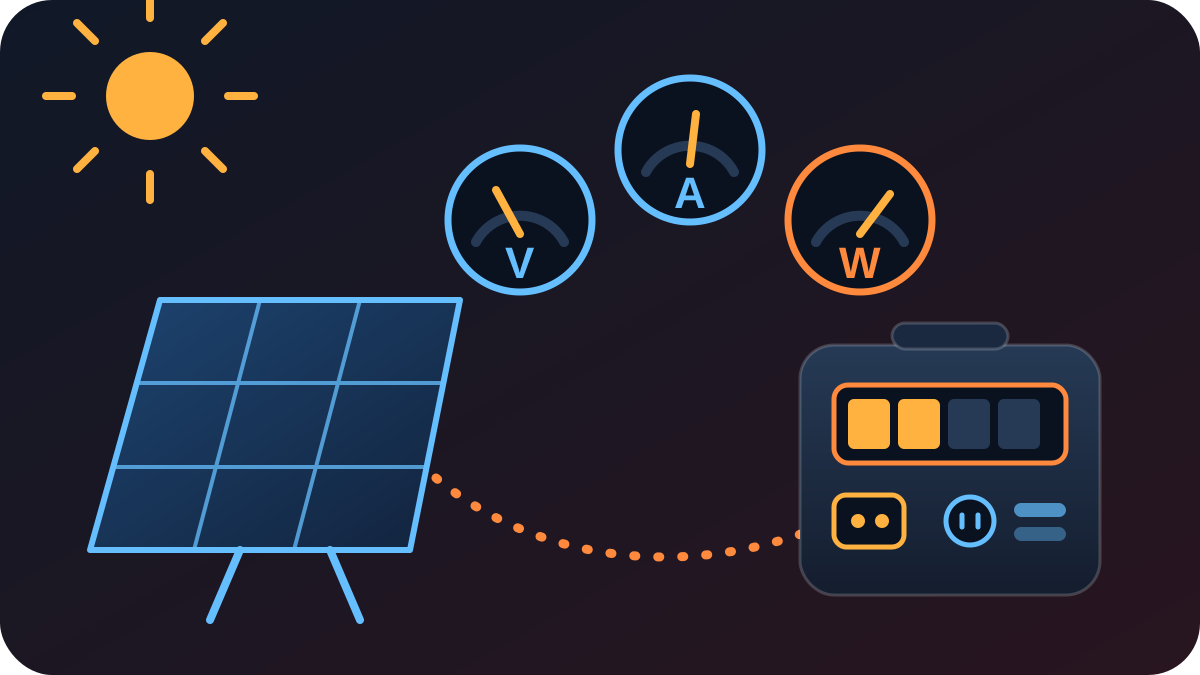
A power station with a solar port lists what that port can accept, and although the list is short, each line answers a different question.
- Voltage range, in volts (V). The top number is the most voltage the input can take. The bottom number is the least it needs before it starts to charge.
- Maximum current, in amps (A). The most current the input is built to carry.
- Maximum solar input, in watts (W). The most power the station will take from panels.
- Plug type. The shape of the solar port.
- Number of solar inputs. Most stations have one. Some larger ones have two.
This guide uses a made-up station for its examples, not a real product. Its solar input accepts 12 to 50 V, up to 15 A and up to 400 W, through one XT60 port.
The three electrical limits stand apart, which means you cannot work one out from the other two. Watts are volts times amps, so you might expect this station to take 50 × 15 = 750 W. It does not, because its watt limit is 400 W. Each limit has to be checked on its own.
cold Voc < maximum input voltsVmp > minimum input voltsWhich numbers on a solar panel do you compare?
A panel's label or spec sheet lists five figures that matter here. All five are measured at a cell temperature of 25 °C in strong sun, known as standard test conditions.
| Panel figure | What it is | Checked against |
|---|---|---|
| Voc, open-circuit voltage | The voltage with nothing connected. It is the highest voltage the panel makes at that temperature. | Maximum input voltage |
| Vmp, working voltage | The voltage while the panel makes its full power. | Minimum input voltage |
| Isc, short-circuit current | The most current the panel can make. | Maximum input current |
| Imp, working current | The current while the panel makes its full power. | Used with Vmp to give watts |
| Rated watts | The panel's full power at standard test conditions. | Maximum solar watts |
The examples use a made-up 100 W panel. Its Voc is 24 V, its Vmp is 20 V, its Isc is 5.3 A and its Imp is 5 A. The working figures give the rated power: 20 × 5 = 100 W.
Solar Gear Scout's compatibility checker makes these same comparisons. It holds Voc against the top of the voltage range, Vmp against the bottom, and Isc against the amp limit. It uses only figures that have been checked against the maker's own documents.
Why must the panel's voltage stay under the maximum?
The top of the voltage range is the one limit you must never cross, because too much voltage can damage the solar input.
The reason is that a station can choose to take less power than a panel offers, but it cannot choose the voltage a panel puts on its port. That voltage is there the moment the panel is plugged in and in the light.
This is why the check uses Voc and not Vmp: Voc is the higher of the two. It appears whenever the station is not drawing power, such as at first light before charging starts or when the battery is full.
One made-up panel has a Voc of 24 V and the made-up station accepts up to 50 V, so a single panel fits with room to spare.
Two of those panels wired in a row add their voltages: 24 × 2 = 48 V. On paper that is still under 50 V, but the next section shows why it is not safe.
Panels make voltage whenever light hits them. This guide covers plugging portable panels into a power station's solar port. A roof array, or anything wired into a house, is a job for a licensed electrician.
Why does cold weather raise panel voltage?
Solar cells make more voltage as they get colder. The Voc on the label is measured at 25 °C, so on a cold, bright morning the real Voc is higher than the label says.
Panel makers publish how much higher, in a figure called the temperature coefficient of Voc. It is given in percent per °C and written as a negative number, such as -0.30% per °C. That means the voltage rises 0.30% for every degree the cells fall below 25 °C.
Solar Gear Scout's product pages run this check for a -10 °C day, which is 14 °F. When a panel's maker publishes no coefficient, the pages assume -0.40% per °C and say that they did. That is the cautious end of typical values, because it gives the higher voltage.
Example A (illustrative): the made-up panel has no published coefficient, so the sum uses 0.40. From 25 °C down to -10 °C is 25 + 10 = 35 degrees. The rise is 35 × 0.40 = 14.0 percent. The cold Voc is 24 × 1.14 = 27.36 V.
Now try two in a row again. 27.36 × 2 = 54.72 V. That is over the station's 50 V maximum. So two of these panels in series pass at 25 °C and fail on a cold morning, and the cold number is the one that counts.
Example B (illustrative): suppose the maker did publish a coefficient of -0.30% per °C. The rise is 35 × 0.30 = 10.5 percent and the cold Voc is 24 × 1.105 = 26.52 V. Two in a row give 26.52 × 2 = 53.04 V. That is still over 50 V.
If you camp where mornings fall below -10 °C, do the sum with your own low, because the colder it gets, the higher the voltage climbs.
What is the minimum voltage, and why does it matter?
The bottom of the voltage range is the start voltage. Below it, the station does not start to charge. Nothing is harmed, but nothing happens at all, which can look like a broken panel.
This check uses Vmp, the voltage the panel holds while it works. The made-up panel has a Vmp of 20 V and the made-up station starts at 12 V, so the panel clears the minimum and charging begins.
Example C (illustrative): a small made-up panel has a Vmp of 9 V. That is under the 12 V start, so one of them will not charge this station. Two in a row give 9 × 2 = 18 V, which clears it. To find how many it takes, divide and round up: 12 ÷ 9 = 1.3, so 2 panels.
Some makers also list a working range for the charger inside the station. It is often called the MPPT range, and its top can be lower than the maximum voltage. When a maker lists one, the panel's working voltage should sit inside it. The compatibility checker counts panels in series against both numbers.
What does the amp limit mean, and what happens above it?
The amp limit is the most current the solar input is built to carry. Hold it against Isc, the most current the panel can make.
The made-up panel's Isc is 5.3 A and the made-up station allows 15 A, so one panel fits easily.
What happens above the limit depends on the station. Some makers state that the station limits the current by itself. With those stations a panel that can make more amps still works, and the station charges at up to its own amp limit. Other makers say nothing either way, and then the spec sheet cannot tell you what the input will do.
The compatibility checker follows that rule. It accepts a panel above the amp limit only when the maker has stated that the station limits current. Without that statement it treats the amp figure as a hard limit and answers no.
Amps matter most when panels are wired side by side, because their currents add. Two of the made-up panels give 5.3 × 2 = 10.6 A, which fits under 15 A. Three give 5.3 × 3 = 15.9 A, which does not. To find how many fit, divide and round down: 15 ÷ 5.3 = 2.8, so 2 panels.
What does the maximum solar watts figure cap?
It caps charging speed: the station takes at most that many watts from its panels, however many you connect.
Example D (illustrative): give the made-up station a 1,000 Wh battery. At its 400 W limit, a full refill takes 1,000 ÷ 400 = 2.5 hours at the very best. With two of the made-up panels the most going in is 100 × 2 = 200 W, and the refill takes 1,000 ÷ 200 = 5.0 hours at best.
Both are best cases, because panels make less than their rated watts for most of the day. Sun angle, cloud, heat and shade all cut the output, so a real refill takes longer.
Can you connect more panel watts than the limit? Yes, as long as the volts and the amps stay inside their own limits. The setup still works and the extra power simply goes unused. Some owners do this on purpose, so that the station gets closer to its limit in weak sun.
The watt limit is the forgiving one and the voltage limit is not. Extra watts never make it safe to go over the maximum voltage.
Series or parallel: how should you link panels?
There are two ways to join panels, and they push on different limits.
Series means one after another. The positive lead of one panel goes to the negative lead of the next. The voltages add up, while the current stays the same as for one panel.
Parallel means side by side. A branch cable joins the positive leads together and the negative leads together. The currents add up, while the voltage stays the same as for one panel.
| Figure | Two in series | Two in parallel |
|---|---|---|
| Voc | 24 × 2 = 48 V | 24 V |
| Isc | 5.3 A | 5.3 × 2 = 10.6 A |
| Rated watts | 100 × 2 = 200 W | 100 × 2 = 200 W |
The power is the same both ways. What changes is the limit you run into: series runs into the voltage limit and parallel runs into the amp limit.
For the made-up station, two in series fail the cold-weather check from Example A. Two in parallel fit every limit, so parallel is the right choice here. A station with a higher voltage limit and a lower amp limit would call for the opposite.
Each way has one more thing going for it. Series keeps the current low, so less power is lost in a long cable, while parallel keeps the voltage low, which leaves more room under the maximum on a cold day.
All of this math assumes the panels are identical. Mixing different panels is harder to predict, so check the panel maker's guidance before you try it.
How many panels can you connect? A worked example.
Here is the whole check in order, with the made-up panel and the made-up station. The panel ends in MC4 connectors and the station has one XT60 solar port.
- Cold voltage. The panel's cold Voc at -10 °C is 27.36 V, from Example A.
- Most panels in series. Divide the maximum voltage by the cold Voc and round down. 50 ÷ 27.36 = 1.8, so 1 panel.
- Fewest panels in series. Divide the start voltage by Vmp and round up. 12 ÷ 20 = 0.6, so 1 panel is enough.
- Most panels in parallel. Divide the amp limit by Isc and round down. 15 ÷ 5.3 = 2.8, so 2 panels.
- Watts. Two panels are rated 100 × 2 = 200 W, under the 400 W limit.
- Plug. MC4 on the panel and XT60 on the station do not match. An MC4 to XT60 adapter cable joins them.
The result: one panel works, and two in parallel work. Two in series do not, and neither do three in parallel. The compatibility checker gives these same answers for these numbers.
With two panels in parallel, the adapter cable carries the current of both, so pick one rated for at least 10.6 A.
Does the plug fit, and when do you need an adapter?
The electrical limits can all pass and the panel can still fail to plug in. Plugs are a separate check.
MC4 is the usual plug on solar panels. It comes as a pair of single locking connectors, one positive and one negative, and it is the plug used to join panels in series or parallel.
Power stations use a wider mix of solar ports, including XT60, XT60i, Anderson Powerpole and round barrel plugs such as DC7909 and DC8020.
- Same plug on both sides. No adapter is needed.
- Different plugs. You need an adapter cable, such as MC4 to XT60. It is a plain cable with a different plug on each end.
- An adapter changes the plug, nothing else. It does not change volts or amps, so every limit above still applies.
- Rate the cable for the current. Pick one rated for at least the panel's short-circuit current, and match positive to positive.
Some plugs look alike and are not the same. XT60i is an XT60 with an added signal pin, and Solar Gear Scout treats the two as different plugs. The name "8 mm" is used loosely for barrel plugs. DC7909 and DC8020 are both about 8 mm wide, but the centre pin is 0.9 mm on one and 2.0 mm on the other. Confirm the exact plug with the maker before you buy a cable.
The compatibility checker names an adapter only when that pair is on its list. When it is not, the checker says it cannot tell yet.
One solar input or two: are the limits shared?
A station with two solar inputs raises one more question. Do the limits apply to each input, or to both together?
Limits for each input. Each port has its own voltage, amp and watt limits. Picture a made-up station with two inputs of 400 W each: it can take 400 × 2 = 800 W in all, but the panels on each port must still fit that port's limits. Makers often print the watt limit as the total for all inputs, so check whether a watt figure is for one port or for all of them.
Shared limits. The figures cover both ports together. A shared 400 W limit means 400 W in all, however the panels are split.
The maker's manual should say which it is, and if it does not, do not guess. The compatibility checker gives no yes or no for a station with more than one solar input until the maker's statement is on file. When it is, the checker's numbers are for one input, and it says whether the limits are shared.
What are the solar input limits of stations on sale now?
The table below is live: it is filled in each time this page loads. It lists the power stations with the most watt-hours per dollar right now, with the solar input limits on file for each. Every figure comes from the maker's own documents. The watts are the total for all of a station's solar inputs. Where a figure has not been checked yet, the table says so.
| Product | Most solar watts, all inputs | Voltage range | Most amps | Plug | Solar inputs |
|---|---|---|---|---|---|
| BLUETTI Elite 400 | 1,000 W | 12 to 60 V | 20 A | XT60 | 1 |
| BLUETTI AC180 Solar | 500 W | 12 to 60 V | 10 A | DC7909 | 1 |
| BLUETTI Elite 300 | 1,200 W | 12 to 60 V | 22 A | XT60 | 1 |
| BLUETTI Elite 200 V2 | 1,000 W | 12 to 60 V | 20 A | XT60 | 1 |
| EcoFlow DELTA 3 Ultra Series | 800 W | 11 to 60 V | 18 A | XT60i | 2 |
| BLUETTI Elite 100 V2 | 1,000 W | 12 to 60 V | 20 A | not on file | not on file |
| EcoFlow DELTA 2 Max | 1,000 W | 11 to 60 V | 15 A | XT60i | 2 (volts and amps are for each input) |
| BLUETTI Apex 300 Versatile | 2,400 W | 12 to 60 V | 20 A | XT60 | 2 (volts and amps are for each input) |
Use the table to see how far apart real stations are, then check your own panel against a station in the compatibility checker. You can browse every tracked unit on the power stations page.
A solar input checklist.
- Find the station's solar facts. Voltage range, amp limit, watt limit, plug and number of inputs.
- Find the panel's figures. Voc, Vmp, Isc, rated watts, plug and the temperature coefficient of Voc.
- Work out the cold Voc. Use the coldest morning you expect.
- Check the maximum voltage. Cold Voc times the panels in series must stay under it.
- Check the minimum voltage. Vmp times the panels in series must be above it.
- Check the amps. Isc times the panels in parallel must fit the amp limit, unless the maker says the station limits current.
- Check the watts. Know that power above the limit goes unused.
- Check the plug. Same plug, or an adapter cable rated for the current.
- Check the inputs. With two solar inputs, find out whether the limits are shared.
- Run the checker. Confirm the pairing in the compatibility checker.
- Compare prices last. Once a panel fits, compare cost per watt among panels that fit.
Common mistakes to avoid.
- Checking Vmp against the maximum voltage. Use Voc. It is higher.
- Forgetting the cold. A string that fits at 25 °C can go over on a frosty morning.
- Adding volts in parallel or amps in series. Series adds volts. Parallel adds amps.
- Multiplying the limits. Maximum volts times maximum amps is not the watt limit.
- Reading the watt limit as a safety limit. It caps speed. The voltage limit is the one that protects the input.
- Missing the start voltage. A small panel under the minimum does not charge at all.
- Assuming the station limits current. Rely on it only when the maker says so.
- Trusting a plug by its looks. XT60 and XT60i differ, and so do the 8 mm barrel plugs.
- Thinking an adapter fixes a mismatch. It changes the plug, not the volts or amps.
- Guessing about two inputs. Shared limits and limits for each input give very different totals.
Related tools and pages.
- Compatibility checker
- Solar recharge estimator
- How to size a portable power station
- Solar panel price per watt
- Portable power stations
- Solar panels
Solar input limits FAQ.
What happens if a solar panel's voltage is too high for a power station?
Too much voltage can damage the solar input. Keep the panel's open-circuit voltage, worked out for your coldest morning, under the station's maximum input voltage.
Can I connect more solar watts than the station's limit?
Yes, as long as the volts and amps stay inside their limits. The station takes at most its watt limit, and the extra power goes unused.
Why will my solar panel not charge my power station?
One common cause is voltage below the station's minimum. If the panel's working voltage is under the start voltage, charging never begins. A plug that does not match is another.
Should I wire two panels in series or in parallel?
It depends on the station's limits. Series adds the voltages, so check the cold Voc of the whole string against the maximum voltage. Parallel adds the currents, so check the total against the amp limit.
Does an MC4 adapter cable change the voltage?
No. An adapter cable changes only the plug. The panel's volts and amps reach the station unchanged, so every limit still applies.
This guide explains the checks made by Solar Gear Scout's compatibility checker. The checker and the live table use only figures checked against each maker's own published documents. Solar Gear Scout has not tested any solar panel or power station. The cold-weather sum uses -10 °C and, when a panel's maker publishes no temperature coefficient, an assumed -0.40% per °C.
The panels and stations in the examples are made up, with round numbers chosen to show the math. They are not real products. The only current product data on this page is in the live table, which is filled in from Solar Gear Scout's data each time the page loads. Read the manuals for your own panel and station before you connect them. Where a manual differs from this guide, follow the manual.