What does the Apex 300 Versatile offer on paper?
The Apex 300 Versatile holds 2764.8 Wh and costs $1,499.00 at BLUETTI. BLUETTI rates it for up to 2400 W of solar input. Panels plug in through 2 ports with xt60 plugs.
BLUETTI also gives it a power lifting rating of 7680 W. Check the label on each appliance you plan to run, and add up the watts before you pick a size. The warranty runs 5 years.
| Power and capacity | |
|---|---|
| Battery capacity | 2764.8 Wh |
| Power lifting | 7680 W |
| Pass-through charging | Yes |
| Solar charging | |
| Max solar input | 2400 W |
| Lowest solar voltage | 12 V |
| Max solar voltage | 60 V |
| Max solar current | 20 A |
| Solar connector | xt60 |
| Solar input ports | 2 ports |
| Works with other brands' panels | Yes |
| Temperature and warranty | |
| Warranty | 5 years |
| Product | Best current price | Watt-hours per dollar | Value rank |
|---|---|---|---|
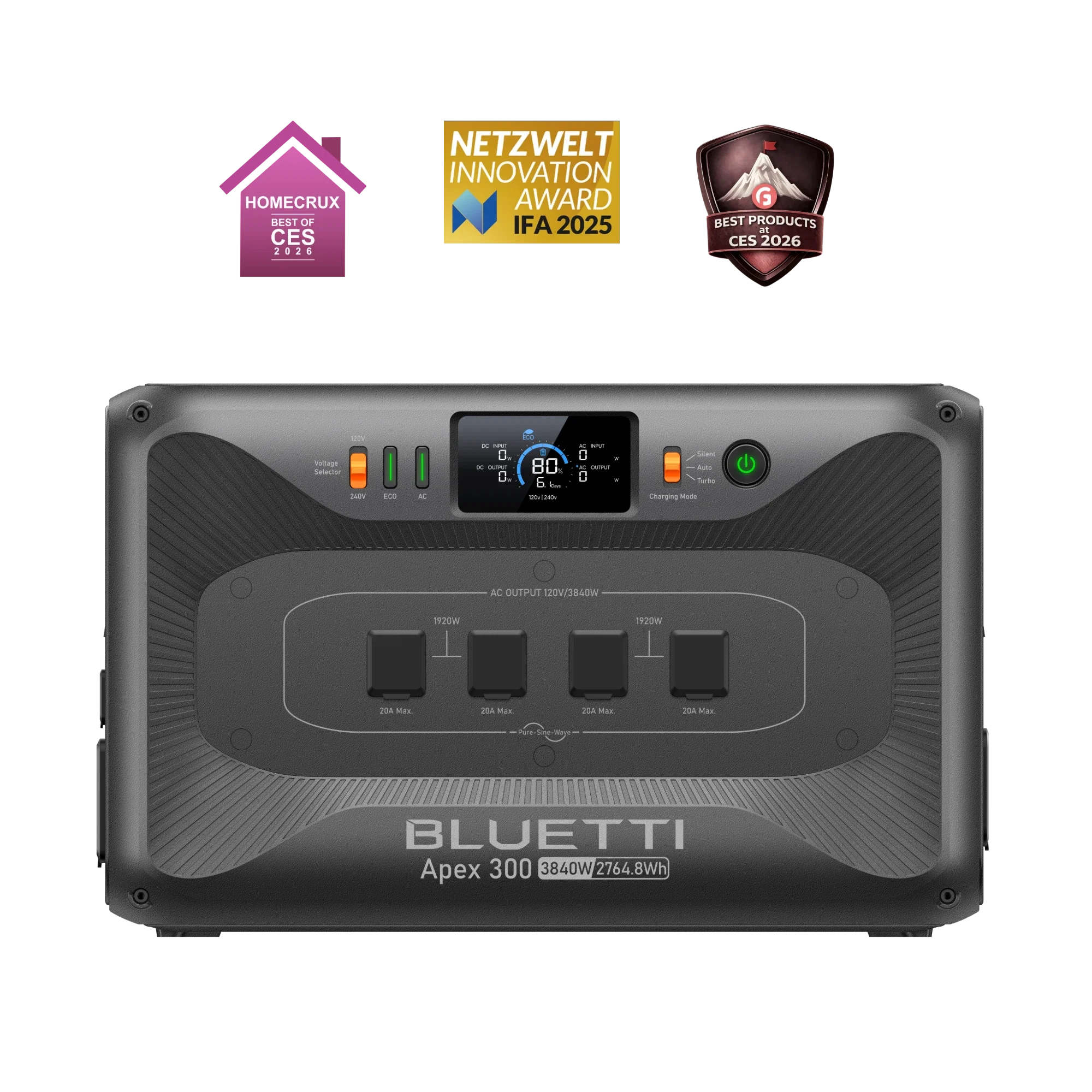 BLUETTI Apex 300 Versatile | $1,499.00 at BLUETTI | 1.84 Wh/$ | #3 of 3 |
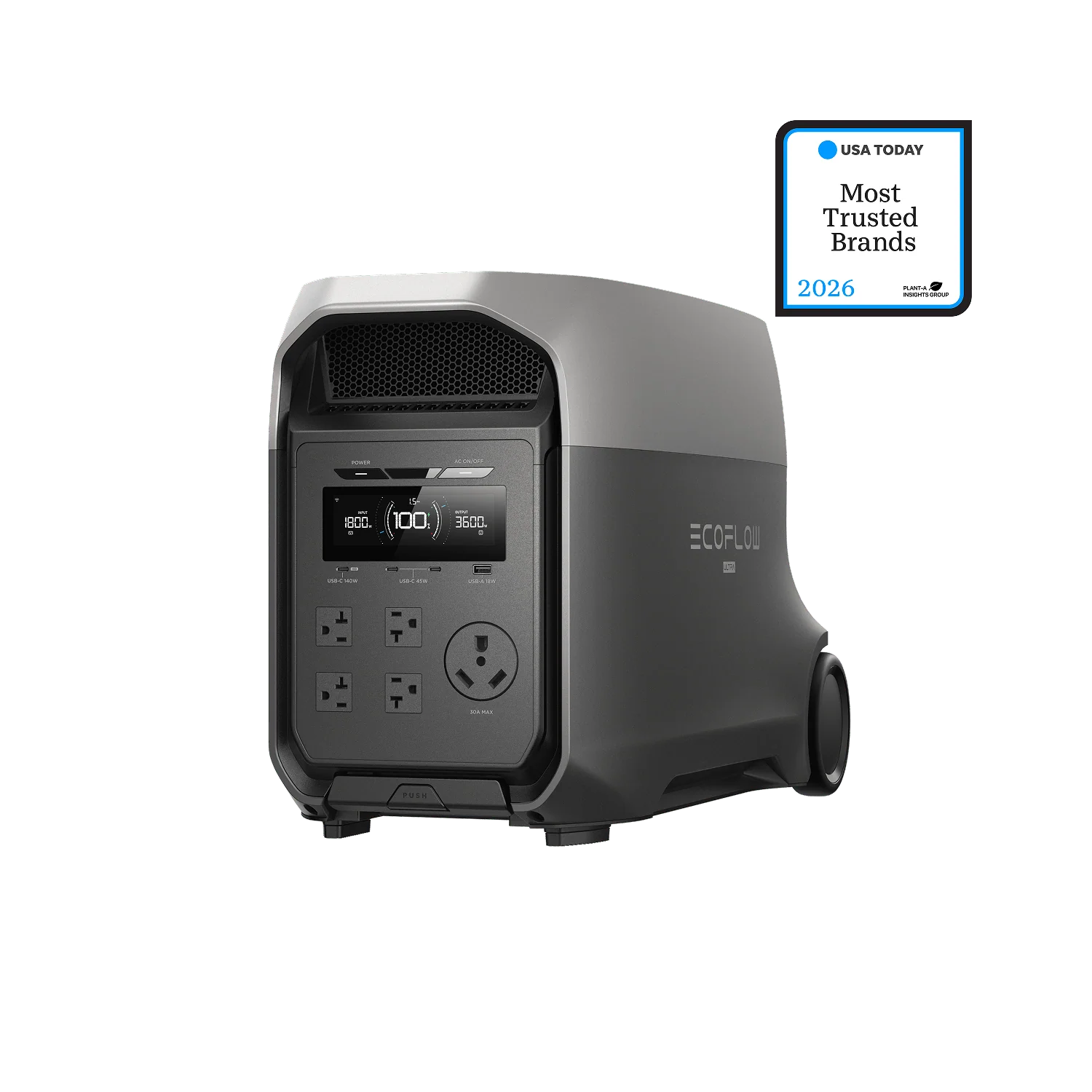 EcoFlow DELTA 3 Ultra Series | $1,199.00 at EcoFlow | 2.56 Wh/$ | #1 of 3 |
 BLUETTI Elite 200 V2 | $849.00 at BLUETTI | 2.44 Wh/$ | #2 of 3 |
How fast does the Apex 300 Versatile charge from the wall and from solar?
From a wall outlet, it reaches 80 percent in 45 minutes by BLUETTI's figure, and the calculated best case for a full solar refill at the max solar input is 1.2 hours. Any best-case solar time assumes full sun on enough panels to reach the top input. The solar input is rated up to 60 V and 20 A per input, with an MPPT minimum of 12 V.
Asked if panels from other brands will work, BLUETTI says yes. Before you buy panels, match their voltage and current to the input range on the spec sheet.
Can it power your devices while it charges?
Yes: BLUETTI states that it supports pass-through charging, and its spec answer is yes. For a home backup role, also look for a stated switchover time.
A shorter switchover time matters for equipment that is sensitive to power drops.
What does the Apex 300 Versatile cost for the energy you get?
At $1,499.00, it works out to 1.84 Wh/$, which ranks #3 of 3 on value in this article. The DELTA 3 Ultra Series ranks #1 of 3 at 2.56 Wh/$, and the Elite 200 V2 ranks #2 of 3 at 2.44 Wh/$.
Watt-hours per dollar shows how much stored energy each dollar buys, not how fast a unit refills, so a lower rank can still be the right buy if charge speed is what you need.
Where is the Apex 300 Versatile strong, and where does it fall short?
Its 2400 W solar input is higher than the 800 W on the DELTA 3 Ultra Series and the 1000 W on the Elite 200 V2. The calculated best case for a full solar refill at the max solar input is 1.2 hours for the Apex 300 Versatile, against 3.8 hours for the DELTA 3 Ultra Series and 2.1 hours for the Elite 200 V2.
Cost is the weak spot: its $1,499.00 price is the highest here, above $1,199.00 for the DELTA 3 Ultra Series and $849.00 for the Elite 200 V2.
Who should buy the Apex 300 Versatile?
If your panels can supply close to 2400 W, it is the only unit here that takes that much, since the others stop at 800 W and 1000 W. It also suits a buyer who wants a wall top-up to 80 percent in 45 minutes, by BLUETTI's figure.
If your budget is tight or your array is small, a unit with a better value rank may serve you better.
How does the EcoFlow DELTA 3 Ultra Series compare?
The DELTA 3 Ultra Series stores more, at 3072 Wh against 2764.8 Wh, and costs less, at $1,199.00 against $1,499.00. EcoFlow rates it for 3600 W of continuous AC output and 7200 W of surge. That puts it in the large-load group, with 2000 W or more of continuous AC output.
For outages, EcoFlow lists a switchover time of 10 ms at most. Its solar side is smaller, with 800 W of input against 2400 W on the Apex 300 Versatile. It weighs 72.1 lb, which is heavy (over 50 lb), and measures 15.6 in long, 12.9 in wide and 24.6 in high.
In the cold, it does not charge below 0 °C. EcoFlow gives a warranty of 5 years, and that is 3 years as standard, plus 2 more when you register it in the EcoFlow app.
Why pick the Elite 200 V2 instead?
Price is the main reason: the Elite 200 V2 costs $849.00 for 2073.6 Wh, a value of 2.44 Wh/$. That is less battery than the 2764.8 Wh in the Apex 300 Versatile, yet it ranks #2 of 3 on value. BLUETTI rates its continuous AC output at 2600 W, with power lifting up to 3900 W.
From the wall, BLUETTI lists 1.4 hours in turbo mode, 1.6 hours in standard mode and 3 hours in silent mode. It has 4 AC outlets, 2 USB-C ports, 2 USB-A ports and 1 car port. BLUETTI quotes a solar charge time of 2.4 hours on 1000 W of solar.
The calculated best case at the max solar input is shorter, at 2.1 hours against the quoted 2.4 hours. At 53.35 lb it is still heavy (over 50 lb), though lighter than the DELTA 3 Ultra Series at 72.1 lb. It cannot add batteries, and it has no built-in light.
Its UPS switchover is 15 ms at most, by BLUETTI's spec.