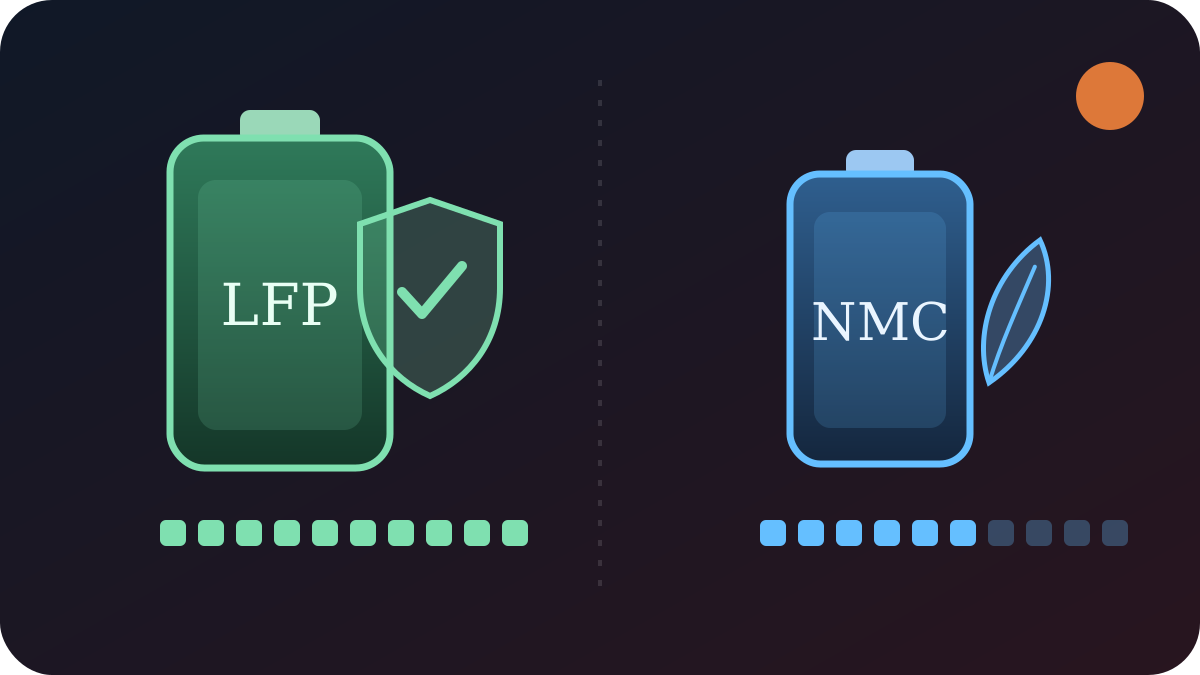
What is LiFePO4, and is it lithium-ion?
Yes, LiFePO4 is a lithium-ion battery. The name comes from what one side of each cell is made of: lithium iron phosphate. You will also see it written as LFP.
Every lithium-ion cell moves lithium back and forth between two sides as it charges and discharges. What changes from one kind to another is mostly the material on the positive side. That material decides how much energy the cell holds, how long it lasts and how it behaves when it gets hot.
In portable power stations, two materials are common:
- LiFePO4 (LFP): lithium iron phosphate.
- NMC: lithium with nickel, manganese and cobalt.
So "LiFePO4 vs lithium-ion" really means "LiFePO4 vs NMC". The rest of this guide compares those two.
Why are the battery names so confusing?
Makers and stores use several names for the same thing. These all mean the same LFP chemistry:
- LiFePO4
- LFP
- Lithium iron phosphate
When a spec sheet says only "lithium-ion" or "Li-ion" and nothing more, it does not tell you which kind. If the chemistry matters to you, look for the cell chemistry line in the spec table or the manual. If it is not there, ask the maker.
Which lasts longer, LiFePO4 or NMC?
LiFePO4 lasts longer. Research by national laboratories finds that LFP cells keep going for more charge cycles than NMC cells before they wear down.
A cycle is one full charge and one full discharge. Every battery loses a little capacity with each cycle, so makers rate it by how many cycles it takes to fall to a set share of its first capacity.
That share matters as much as the number of cycles. A rating can end at 70% or at 80% of the first capacity, and those are not the same test. For example, one maker's manual we hold rates its LiFePO4 station for 4,000 cycles to 70% capacity.
Example (illustrative): a station charged and used once every day would take 4,000 ÷ 365 = 11.0 years to reach 4,000 cycles. If it started with 1,000 Wh, it would still hold about 1,000 × 0.70 = 700 Wh at the end of that rating. It would not stop working at that point; it would just hold less.
Most people use a power station far less often than once a day. For them, age and how the station is stored can matter more than the cycle count.
When you compare two ratings, check that both end at the same share. Use the maker's own figure from its spec sheet or manual, not a figure from an ad.
Which is lighter for the same battery size?
NMC is lighter. It stores more energy for its weight than LiFePO4, so an NMC station of the same size usually weighs less. That is why NMC can suit small stations meant to be carried a long way.
You can see the difference in a spec sheet by working out the watt-hours per pound: the battery size divided by the weight. A higher number means less weight to carry for each unit of energy.
Example (illustrative): made-up Station A holds 1,000 Wh and weighs 25 lb. That is 1,000 ÷ 25 = 40 Wh per pound. Made-up Station B holds the same 1,000 Wh and weighs 20 lb, which is 1,000 ÷ 20 = 50 Wh per pound. Station B carries the same energy for 5 fewer pounds.
Weight per watt-hour is not only about the cells. The case, the inverter, the handles and the wheels all add weight too. So use the figure to compare stations, not to guess the chemistry.
The live table below works out the watt-hours per pound for each power station, from the maker's own weight and battery size.
Which battery handles heat better?
LiFePO4 handles heat better. Government reports class LFP as the safer of the two, and a federal test found that LFP cells needed more heat before they failed than the NMC cells tested alongside them.
That is a real advantage for a box you keep in a car, a garage or a tent in the sun. It does not make any battery fireproof. A LiFePO4 station can still be damaged by a crash, a puncture, water or the wrong charger.
- Keep any power station out of direct sun on a hot day, and away from heaters.
- Do not use a station that is swollen, cracked, leaking or smells odd.
- Use the charger and cables the maker lists.
- Follow the manual's temperature limits for charging and for use.
What happens in cold weather?
Cold is where the manuals matter most. The rule in every LiFePO4 power station manual we checked is the same: do not charge it below freezing.
We checked the manuals of seven LiFePO4 power stations that list a charging range. All seven start at 0 °C (32 °F). Their top limit is 40 to 45 °C (104 to 113 °F).
Using the station in the cold is a different story. Five of those manuals let the station run down to -20 °C (-4 °F). So a LiFePO4 station can power things on a frosty morning, but it will not take a charge until it warms up.
- Warm it before you charge it. Bring it inside and let it reach room temperature first.
- Plan solar charging for the warm part of the day. A station left outside overnight may refuse to charge at sunrise.
- Expect less run time in the cold. Manuals warn that low temperatures can cut the battery capacity and the run time.
Some makers sell stations or batteries that warm their own cells before charging. If you need to charge below freezing, look for that feature in the maker's spec sheet, and check the charging range it states.
Does the chemistry change the price?
A little. LiFePO4 batteries cost less to make than NMC batteries, though the gap changes over time and from report to report.
The price of a power station depends on far more than its cells: the inverter, the ports, the solar input, the app, the warranty and the brand. So do not expect a LiFePO4 station to be cheap just because of its chemistry.
The fair way to compare is watt-hours per dollar: the battery size divided by the price. Solar Gear Scout ranks every power station this way. The sizing guide explains how to pick the battery size first.
What about sodium-ion batteries?
A few new power stations use a third kind of cell: sodium-ion. It uses sodium in place of lithium.
The one sodium-ion power station whose manual we hold lists charging down to -15 °C (5 °F). Below 0 °C, that manual limits how full it will charge: up to 70% between -10 °C and 0 °C, and up to 60% below -10 °C.
That makes sodium-ion worth a look if you charge in the cold. It is still new in power stations, so check the maker's own figures for weight, cycle rating and price before you choose it.
How do you make a power station battery last?
The habits are much the same for both chemistries. Your own manual comes first, but these are the common rules.
- Charge and use it now and then. Six of the manuals we checked ask you to fully charge and run down the station every 3 to 6 months when it sits unused.
- Store it partly charged, somewhere cool and dry. Check the manual for the charge level it wants for long storage.
- Avoid heat. A hot car or a sunny window wears any battery faster.
- Charge only inside the temperature range the manual gives.
- Keep the firmware up to date if the station has an app.
How do you choose between LiFePO4 and NMC?
| What matters most | Leans toward | Why |
|---|---|---|
| Many years of use | LiFePO4 | It lasts more charge cycles. |
| Daily solar charging | LiFePO4 | Frequent cycles add up fast. |
| Hot car, garage or tent | LiFePO4 | It handles heat better. |
| Carrying it far by hand | NMC | It stores more energy per pound. |
| Charging below freezing | Check the maker | Look for a stated charging range below 0 °C, a self-heating battery or sodium-ion. |
| Lowest price for its size | Compare Wh per dollar | The station's price depends on much more than its cells. |
For most buyers, LiFePO4 wins. NMC makes sense mainly for small stations you carry a long way, where every pound counts.
Which power stations are on sale now, and what do they use?
The table below is live: it is filled in each time this page loads. It lists the best-value power stations right now, with the cell chemistry each maker states, the battery size, the weight and the watt-hours per pound.
| Product | Chemistry | Battery | Weight | Battery per pound | Value |
|---|---|---|---|---|---|
| BLUETTI Elite 100 mini | LiFePO4 (LFP) | 1,004.8 Wh | not on file | not on file | 2.34 Wh/$ |
| BLUETTI AC180 Solar | LiFePO4 (LFP) | 1,152 Wh | 36.2 lb | 31.9 Wh per lb | 2.31 Wh/$ |
| BLUETTI Elite 200 V2 | LiFePO4 (LFP) | 2,073.6 Wh | 53.4 lb | 38.9 Wh per lb | 2.31 Wh/$ |
| EcoFlow DELTA 2 Max | LiFePO4 (LFP) | 2,048 Wh | 50.7 lb | 40.4 Wh per lb | 1.95 Wh/$ |
| BLUETTI Elite 300 | LiFePO4 (LFP) | 3,014 Wh | 58 lb | 52 Wh per lb | 1.77 Wh/$ |
| BLUETTI Apex 300 Versatile | not on file | 2,764.8 Wh | not on file | not on file | 1.73 Wh/$ |
| BLUETTI Premium 200 V2 | not on file | 2,073.6 Wh | not on file | not on file | 1.34 Wh/$ |
| BLUETTI Elite 10 Mini | not on file | 128 Wh | not on file | not on file | 1.08 Wh/$ |
| BLUETTI Pioneer Na(Sodium) | Sodium-ion | 900 Wh | 35.3 lb | 25.5 Wh per lb | 1.00 Wh/$ |
| BLUETTI Elite 30 V2 | not on file | 288 Wh | not on file | not on file | 0.99 Wh/$ |
Each product page lists the maker's own battery and weight figures. You can browse every tracked station on the power stations page.
A battery chemistry checklist.
- Find the cell chemistry. Look for LiFePO4, LFP, NMC or sodium-ion in the spec table or manual.
- Read the cycle rating. Note both the number of cycles and the share of capacity it ends at.
- Work out watt-hours per pound. Battery size divided by weight, if you will carry it far.
- Check the charging temperature range. Most start at 0 °C (32 °F).
- Check the use range. Many can run in colder weather than they can charge in.
- Compare watt-hours per dollar. Battery size divided by price.
- Read the storage advice. How often to cycle it and how full to keep it.
Common mistakes to avoid.
- Thinking LiFePO4 is not lithium-ion. It is a kind of lithium-ion battery.
- Comparing cycle ratings that end at different capacities. 70% and 80% are different tests.
- Charging a cold station. Warm it up first unless the maker says it can charge below freezing.
- Leaving a station in a hot car. Heat wears any battery faster.
- Picking a battery by chemistry alone. Size, output, solar input and price matter as much.
- Guessing the chemistry from the weight. The case and inverter add weight too. Read the spec table.
Related tools and pages.
- How to size a portable power station
- What a power station's solar input limits mean
- Solar recharge estimator
- Off-grid or hybrid inverter
- Power stations
LiFePO4 vs lithium-ion FAQ.
Is LiFePO4 better than lithium-ion?
LiFePO4 is a kind of lithium-ion battery. Compared with NMC, the other common kind, it lasts more charge cycles and handles heat better, but it weighs more for the same energy. For most power station buyers, it is the better choice.
Is a LiFePO4 power station safer?
LFP handles heat better than NMC, so it is the safer chemistry. No battery is fireproof, though. Follow the manual, use the maker's charger and stop using a station that is damaged or swollen.
Can I charge a LiFePO4 power station in freezing weather?
Usually not. Every LiFePO4 power station manual we checked starts its charging range at 0 °C (32 °F). Warm the station up first, unless the maker states a lower charging range.
How long does a LiFePO4 power station last?
Check the maker's cycle rating and the capacity it ends at. One maker's manual we hold rates its LiFePO4 station for 4,000 cycles to 70% capacity. Used once a day, that is about 11 years.
Why do some power stations still use NMC?
NMC stores more energy for its weight, so it suits small stations meant to be carried a long way.
The general comparisons on this page each rest on two published sources: a U.S. Department of Energy battery report (2023), International Energy Agency battery analysis (2024), a Pacific Northwest National Laboratory cost and performance report (2020), a NIOSH and NIST battery failure study, and research shared by Sandia National Laboratories scientists. Figures for specific power stations come from the makers' own manuals, read and checked by Solar Gear Scout. Solar Gear Scout has not tested any battery or power station.
The two stations in the weight example are made up, with round numbers chosen to show the math. They are not real products. The only current product data on this page is in the live table, which is filled in from Solar Gear Scout's data each time the page loads. Where your own manual differs from this guide, follow the manual.