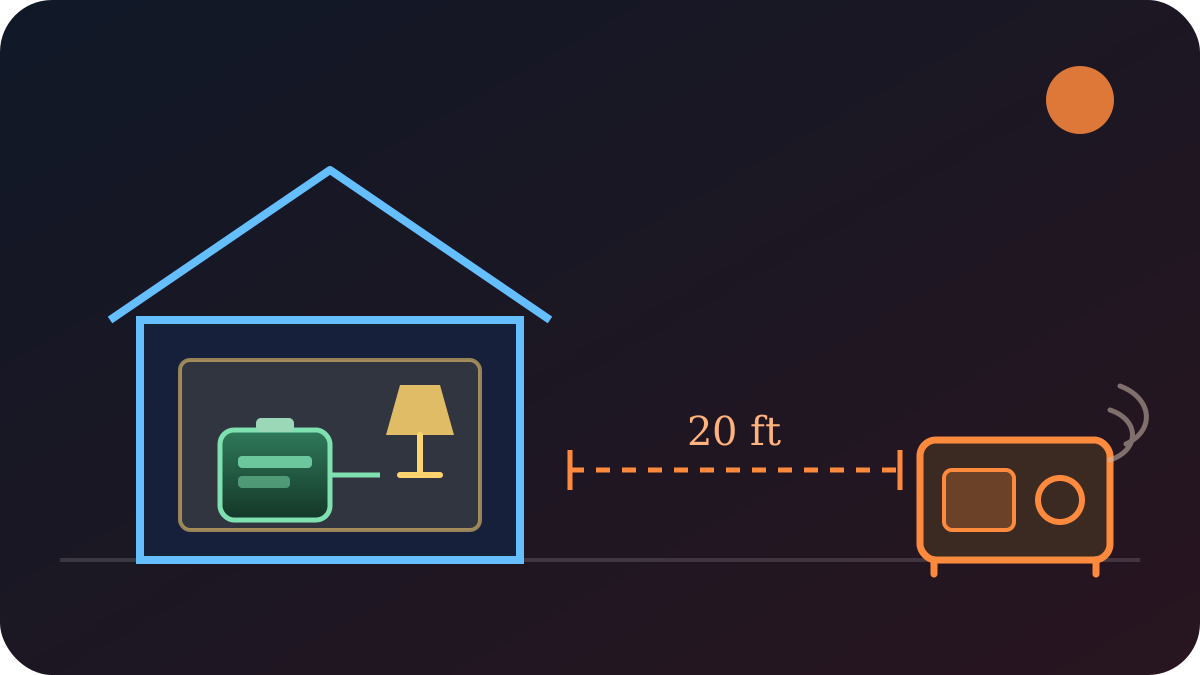
How does a power station differ from a generator?
They solve the same problem in different ways.
- A portable power station is a large battery with an inverter and outlets built in. It stores power you put in earlier, from a wall outlet, solar panels or a car, and gives it back when you need it. It burns nothing.
- A gas generator has an engine that burns gasoline, propane or another fuel to make power as you use it. It makes power for as long as it has fuel.
That one difference decides almost everything else: where you can use each one, how long it lasts, how loud it is and how you keep it going.
Which is safer to use at home?
The biggest danger with a generator is carbon monoxide (CO). An engine gives off this gas, and it has no smell or color, so you cannot tell it is there. Government safety agencies are clear about the rules:
- Never run a generator indoors, in a garage, basement or shed, even with the doors and windows open.
- Run it outside, at least 20 feet from doors, windows and vents.
- Install CO alarms in your home, near where people sleep.
- Turn it off and let it cool before you add fuel.
A power station burns no fuel, so it gives off no exhaust. That is why you can keep one inside next to a bed or a fridge. In fact, two of the power station manuals we hold say the device is for indoor use only, to keep it out of rain and snow.
A power station still needs care: keep it dry, give it room to breathe, and follow its manual. The LiFePO4 guide covers battery safety.
Which one runs longer in an outage?
A generator, as long as you keep refueling it. A power station runs until its battery is empty, then needs recharging.
To estimate a power station's run time, divide its battery size in watt-hours by what you plug in, in watts. That gives the hours before losses; real run time is a little shorter.
Example (illustrative): a made-up power station holds 2,000 Wh. A made-up fridge uses 100 W on average over a day, since its compressor switches on and off. The fridge could run for about 2,000 ÷ 100 = 20 hours before losses.
For a longer outage, add up the energy you need. That same fridge uses 100 × 24 = 2,400 Wh a day, so three days would take 100 × 24 × 3 = 7,200 Wh. That is more than most single power stations hold, unless you can recharge during the outage.
The power station sizing guide works through run time in detail.
Which can power more at once?
Both have a limit on how many watts they can give at the same time. For a power station, it is the inverter's AC output rating. For a generator, it is its running watts rating.
Check the rating on each. Big motor loads, such as a well pump or a window air conditioner, need a large output rating. On a power station they also empty the battery fast, so a large load shortens the run time a lot.
Either way, add up what you will run at the same time and allow for motors that need a burst to start. The inverter sizing guide shows how, step by step.
Which one is quieter?
A power station, by a wide margin. It has no engine. The only sound is a cooling fan. Two of the power station manuals we hold list their noise at up to 50 dB.
A generator's engine runs the whole time it is on, so you hear it the whole time. That matters at night, in a quiet neighborhood, or if you need sleep through a long outage.
How do you recharge or refuel each one?
A power station recharges from:
- a wall outlet, before the outage or when power returns;
- solar panels, during the day, which works even in a long outage;
- a car's 12 V socket, slowly;
- a generator. Eight of the power station manuals we hold list a generator as a way to charge.
Five of those manuals add a condition: the generator should give pure sine wave power at the right voltage and frequency. Check your generator's spec sheet for pure sine wave output before you rely on it.
A generator needs fuel. Store it in containers made for fuel, away from heat and outside living areas, and refuel only when the engine is off and cool. Plan how much fuel you can store safely before an outage.
The solar input guide shows how to check which panels work with a power station.
Can either one power your house wiring?
Not by plugging it into a wall outlet. Feeding power back through an outlet, called backfeeding, is extremely dangerous. The power can travel out onto the utility lines and electrocute line workers and neighbors.
To power circuits in your home, you need a transfer switch installed by a qualified electrician. It keeps your backup power and the utility's power apart. If you want a power station to power house circuits, ask its maker which transfer switch or home panel it supports; that also needs a qualified electrician.
The simple, safe way for most people is to plug devices straight into the power station or generator. With a generator, use a heavy-duty outdoor extension cord so it can stay 20 feet from the house.
Which costs more?
They cost money in different ways.
- A power station is mostly an up-front cost. After that you recharge it from the wall or the sun, and its battery wears slowly with use.
- A generator has an up-front cost too, and then needs fuel every time it runs, plus engine care such as oil changes.
To compare power stations fairly, use watt-hours per dollar: the battery size divided by the price. Solar Gear Scout ranks every power station this way, and the live table below shows today's best values.
Why use both?
Because each covers the other's weak spot. A power station runs the fridge, lights and phones quietly inside, all night. When its battery runs low, a generator outside, at a safe distance, recharges it for an hour or two in the daytime. You run the generator less, use less fuel and sleep without engine noise.
If you add solar panels, the power station can refill on sunny days without the generator at all.
How do you choose?
| Your situation | Leans toward | Why |
|---|---|---|
| Apartment, or no safe outdoor spot | Power station | A generator must run outside, 20 feet from the home. |
| Short outages, a few hours to a day | Power station | Quiet, indoors, no fuel to store. |
| Medical device such as a CPAP | Power station | It runs next to the bed, silently. |
| Outages of several days | Both, or a generator | A battery alone runs out; fuel or solar keeps it going. |
| Well pump or large air conditioner | Generator | Large motor loads need more watts. |
| Powering house circuits | Either, with a transfer switch | Installed by a qualified electrician. |
Which power stations are on sale now?
The table below is live: it is filled in each time this page loads. It lists the best-value power stations right now, with each one's battery, continuous output and a simple run time for a 100 W load.
| Product | Battery | Continuous output | Best current price | Most hours at 100 W |
|---|---|---|---|---|
| BLUETTI Elite 100 mini | 1,004.8 Wh | 700 W | $429.00 | 10.0 |
| BLUETTI AC180 Solar | 1,152 Wh | 1,800 W | $499.00 | 11.5 |
| BLUETTI Elite 200 V2 | 2,073.6 Wh | 2,600 W | $899.00 | 20.7 |
| EcoFlow DELTA 2 Max | 2,048 Wh | 2,400 W | $1,049.00 | 20.5 |
| BLUETTI Elite 300 | 3,014 Wh | 2,400 W | $1,699.00 | 30.1 |
| BLUETTI Apex 300 Versatile | 2,764.8 Wh | not on file | $1,599.00 | 27.6 |
| BLUETTI Premium 200 V2 | 2,073.6 Wh | not on file | $1,549.00 | 20.7 |
| BLUETTI Elite 10 Mini | 128 Wh | not on file | $119.00 | 1.3 |
You can browse every tracked station on the power stations page.
A home backup checklist.
- List what you must keep running. Fridge, medical devices, lights, phones, internet.
- Add up the watts that run at the same time, and the watt-hours per day.
- Decide how long an outage you plan for. Hours, a day or several days.
- Check where you could run a generator. Outside, at least 20 feet from doors, windows and vents.
- Plan how to recharge or refuel. Solar, generator, or stored fuel in approved containers.
- Install CO alarms near where people sleep.
- Use a transfer switch installed by a qualified electrician for house circuits, or plug devices in directly.
Common mistakes to avoid.
- Running a generator in a garage, even with the door open.
- Setting a generator by a window or door. Keep it at least 20 feet away.
- Plugging a generator into a wall outlet. Backfeeding can kill line workers.
- Refueling a hot generator. Turn it off and let it cool first.
- Expecting a power station to run a house for days. Do the watt-hour math first.
- Forgetting to charge the power station before storm season.
- Charging a power station from a generator without checking the manual's requirements.
Related tools and pages.
- How to size a portable power station
- What size inverter do I need?
- LiFePO4 vs lithium-ion
- What a power station's solar input limits mean
- Solar recharge estimator
- Power stations
Power station vs generator FAQ.
Is a power station better than a generator?
For quiet, indoor backup through short outages, yes. For large loads over several days, a generator, or a generator recharging a power station, does more.
Can I use a power station indoors?
Yes. It burns no fuel and gives off no exhaust. Some makers' manuals say their stations are for indoor use only. Keep it dry and follow its manual.
Can I run a generator in my garage with the door open?
No. Safety agencies say never to run a generator indoors or in a garage, even with doors and windows open. Run it outside, at least 20 feet from doors, windows and vents.
Can a generator charge a power station?
Many power stations can charge from one. Eight of the power station manuals we hold list a generator as a charging method, and several ask for pure sine wave power at the right voltage and frequency.
How long will a power station run a refrigerator?
Divide the station's watt-hours by the fridge's average watts. A 2,000 Wh station and a fridge averaging 100 W gives about 20 hours before losses.
The generator safety rules on this page each rest on two published sources: fact sheets from the U.S. Centers for Disease Control and Prevention (CDC), the Consumer Product Safety Commission (CPSC), the Occupational Safety and Health Administration (OSHA) and the National Fire Protection Association (NFPA). Statements about power stations come from the makers' own manuals, read and checked by Solar Gear Scout. Solar Gear Scout has not tested any power station or generator.
The power station and the fridge in the examples are made up, with round numbers chosen to show the math. They are not real products. The only current product data on this page is in the live table, which is filled in from Solar Gear Scout's data each time the page loads. Where your own manual differs from this guide, follow the manual.