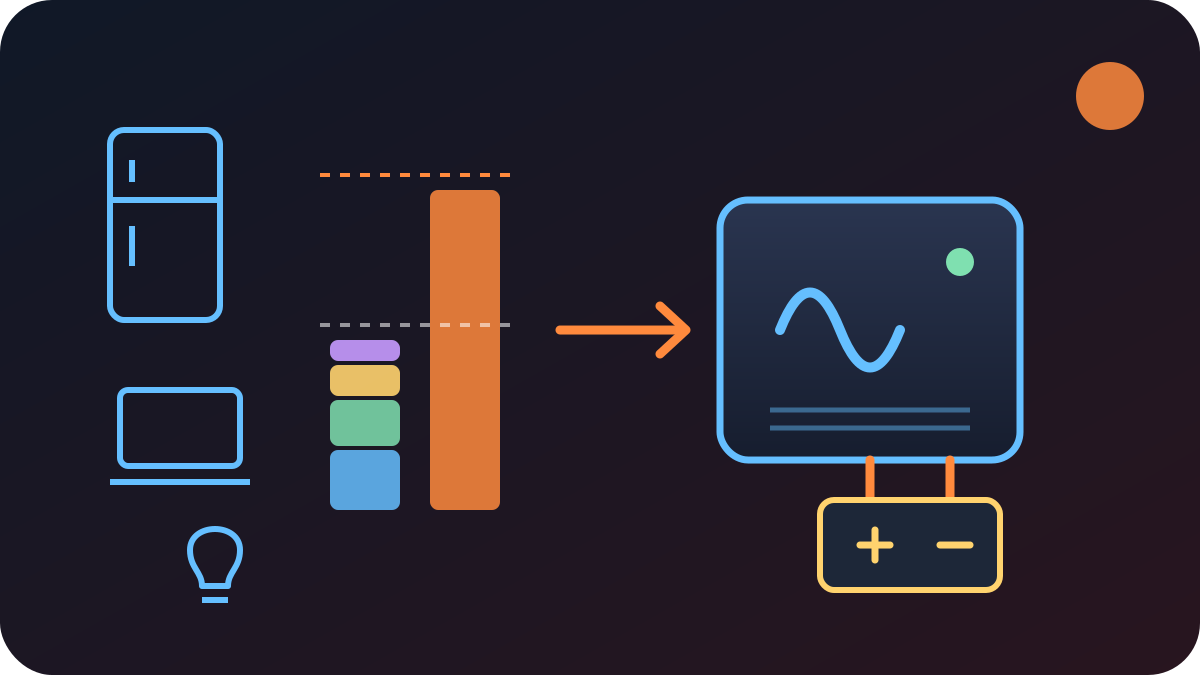
What are running watts and starting watts?
Running watts are what a device uses once it is going. They are also called rated or continuous watts. A lamp, a laptop charger or a phone uses about the same power the whole time it is on.
Starting watts are a short burst a device needs to get going. They are also called surge or peak watts. Devices with a motor or a compressor need this burst: a refrigerator, a freezer, a well pump, an air conditioner, some power tools. The burst lasts a moment, but it can be several times the running watts.
Your inverter has the same two figures:
- Continuous output is what it can deliver hour after hour.
- Surge output is the extra it can give for a short time, to start motors.
One inverter maker puts it simply in its manual: some devices "have an initial high power surge to start".
Where do you find a device's watts?
- The label or nameplate. Most devices list watts (W) near the power cord or on the back.
- Only amps listed? Multiply by the voltage. A device that draws 5 A at 120 V uses 120 × 5 = 600 W.
- Two figures on the label? Some devices list both what they deliver and what they draw. Use the figure for the power it draws, which is the larger one.
- Starting watts are often not on the label. Look in the manual or ask the maker. Compressors often list a locked rotor current (LRA); the off-grid vs hybrid guide explains how to use it.
- Measure it. A plug-in power meter shows what a device really draws while it runs.
How do you size an inverter, step by step?
Here are four steps, using a made-up van setup as the example. The devices and their watts are illustrative, not real products.
- List what runs at the same time. A fridge (150 W running, 600 W starting), a laptop (90 W), lights (30 W) and a fan (40 W).
- Add up the running watts. 150 + 90 + 30 + 40 = 310 W. The continuous rating must be above this.
- Add the biggest start. The worst moment is the fridge starting while everything else runs. Use its starting watts in place of its running watts: 600 + 90 + 30 + 40 = 760 W. The surge rating must be above this.
- Leave headroom. Choose an inverter whose continuous rating sits well above the running total, so it is not working at its limit, and so you can add a device later.
For this van, an inverter rated about 500 W continuous with 1,000 W surge would cover it. A 1,000 W inverter would leave room to grow.
Only add the starts of devices that can start at the same moment. Two compressors that might switch on together both count. A device you only use on its own, such as a vacuum, only matters when nothing big is running.
How long does an inverter's surge last?
It depends on the inverter, and the spec sheet tells you. That time matters: a motor that needs a few seconds to get up to speed needs a surge that lasts that long.
- One maker's 12 V inverters list "up to 2x surge for start-up loads", and their spec table rates that surge for 1 second.
- Larger inverter/chargers often list several surge levels. Two maker spec sheets we hold list surge for 5 seconds, 5 minutes and 30 minutes, with the watts falling the longer it lasts.
So two inverters with the same surge watts are not equal if one holds it for 1 second and the other for 5 seconds. For motors, compare the surge at the same duration.
Why leave headroom? Heat lowers the rating.
An inverter's continuous rating is set at a stated temperature. The manuals and spec sheets we hold for three inverter brands give their continuous rating at 25 °C (77 °F).
Above that, output can drop. One maker's manual says its inverters lose 1% of their rated wattage for every degree above 25 °C.
Example (illustrative): by that rule, a made-up 3,000 W inverter in a 35 °C (95 °F) cabinet would deliver 3,000 × 0.90 = 2,700 W. Check your own inverter's manual for its rule.
Headroom also lets the inverter run cooler and quieter, and it leaves room for the next device you add.
How much current will the inverter draw from the battery?
This is the step people skip, and it decides your cables, fuses and battery. The inverter turns the battery's low DC voltage into 120 V AC. To deliver the same watts at a low voltage, it has to draw a lot of current.
The rule is: amps = watts ÷ battery volts ÷ efficiency. Efficiency is the share of power that gets through; the rest becomes heat. One maker states its 12 V inverters convert above 90%, and another lists a peak of 88%.
Example (illustrative): a made-up 2,000 W load on an inverter that is 90% efficient:
| Battery | Current from the battery |
|---|---|
| 12 V | 2,000 ÷ 12 ÷ 0.9 = 185.2 A |
| 24 V | 2,000 ÷ 24 ÷ 0.9 = 92.6 A |
| 48 V | 2,000 ÷ 48 ÷ 0.9 = 46.3 A |
The makers size the fuses to match. One maker's manual for its 12 V inverters lists a battery fuse of 100 A for the 700 W model, rising to 400 A for the 3,000 W model.
Current that high needs thick, short cables and the right fuse. Use the cable and fuse sizes in your inverter's manual, and have a licensed electrician do any wiring into a house.
Should you choose a 12, 24 or 48 V system?
Battery voltage is the other half of sizing. The higher the voltage, the less current for the same watts, as the table above shows: doubling the voltage halves the current.
- 12 V suits small systems in cars, vans and boats, where the battery is already 12 V and the inverter is a few hundred to a few thousand watts.
- 24 V suits mid-size systems where 12 V cables would get too thick.
- 48 V suits large home and cabin systems. Most of the large inverter/chargers we track are built for 48 V batteries.
The inverter must match the battery's voltage. A 12 V inverter cannot run from a 48 V battery, so pick the system voltage first.
Example: can one inverter run a microwave and a coffee maker?
Example (illustrative): a made-up microwave draws 1,100 W and a made-up coffee maker draws 900 W. Neither has a motor to start, so their running watts are what count.
- On their own, either one fits a made-up 1,500 W inverter.
- Together they draw 1,100 + 900 = 2,000 W. That is over 1,500 W, so the inverter would shut down or refuse the load.
You have two choices: run them one at a time, or choose an inverter rated well above 2,000 W continuous. Kitchen devices that heat are some of the biggest loads in a home, so check them first.
Does a power station follow the same rules?
Yes. A portable power station has an inverter inside. Its AC output rating is its continuous watts, and its surge rating covers starts. The same four steps apply.
The difference is that a power station's battery and cables are built in, so you can skip the battery current step. You still need to know how long the battery lasts, which the power station sizing guide works out.
Which inverters are on sale now?
The table below is live: it is filled in each time this page loads. It lists the best-value inverters right now, with the continuous output, surge and battery voltage their makers state.
| Product | Continuous output | Surge | Battery voltage | Value |
|---|---|---|---|---|
| Renogy 3000W 12V Pure Sine Wave Inverter | 3,000 W | 6,000 W for 1 s | 12 V | 7.23 W/$ |
| Renogy 3000W 12V Pure Sine Wave Inverter with UPS Transfer Switch | 3,000 W | 6,000 W for 2 s | 12 V | 6.49 W/$ |
| Renogy 1000W 12V Pure Sine Wave Inverter | 1,000 W | 2,000 W for 1 s | 12 V | 5.68 W/$ |
| Renogy 2000W 12V Pure Sine Wave Inverter with UPS Transfer Switch and Built-in Bluetooth | 2,000 W | 4,000 W for 2 s | 12 V | 5.48 W/$ |
| Renogy 3500W 48V Solar Inverter Charger | 3,500 W | not on file | 48 V | 4.55 W/$ |
| Renogy 1000W 12V Pure Sine Wave Inverter with UPS Transfer Switch | 1,000 W | 2,000 W for 2 s | 12 V | 3.70 W/$ |
| EG4 Electronics FlexBOSS21 Hybrid Inverter | 16,000 W | 24,000 W for 0.5 s | 51.2 V | 3.61 W/$ |
| EG4 Electronics 6000XP Off-Grid Inverter | 6,000 W | 12,000 W for 3.5 s | 48 V | 3.16 W/$ |
| EG4 Electronics 12kPV Hybrid Inverter | 8,000 W | 16,000 W for 0.5 s | 48 V | 2.63 W/$ |
| MidNite Solar Little Rosie MNLR4548RE Inverter/Charger | 4,500 W | 6,750 W for 5 s | 48 V | 2.63 W/$ |
Each product page lists the maker's own figures. The off-grid vs hybrid guide explains the types, and you can browse every tracked inverter on the inverters page.
An inverter sizing checklist.
- List your devices. Mark which ones run at the same time.
- Find each device's running watts. Label, volts × amps, manual or a power meter.
- Find the starting watts of anything with a motor or compressor.
- Add the running watts. That sets the continuous rating.
- Swap in the biggest start. That sets the surge rating.
- Check how long the surge lasts. Compare at the same duration.
- Leave headroom. Ratings are set at 25 °C and can drop in heat.
- Work out the battery current. Watts ÷ volts ÷ efficiency.
- Pick the system voltage. Higher voltage for bigger inverters.
- Use the manual's cable and fuse sizes. And an electrician for house wiring.
Common mistakes to avoid.
- Sizing for running watts only. A fridge or pump can trip an inverter that ignores the starting surge.
- Adding up every device you own. Only what runs at the same time counts.
- Comparing surge without the time. 1 second and 5 seconds are not the same.
- Running at 100% all day. Leave headroom, especially in a hot space.
- Forgetting the battery side. A big inverter on 12 V draws a very large current.
- Using thin cables or no fuse. Follow the manual's sizes.
- Running two heating devices at once. Microwaves, kettles and coffee makers add up fast.
Related tools and pages.
- Off-grid or hybrid inverter: which do you need?
- How to size a portable power station
- LiFePO4 vs lithium-ion
- Compatibility checker
- Inverters
Inverter sizing FAQ.
What size inverter do I need to run a refrigerator?
Find the fridge's running and starting watts in its manual or on its label. The continuous rating must cover the running watts plus anything else on at the same time, and the surge rating must cover the starting watts plus the rest, for long enough to start the compressor.
What is the difference between starting watts and running watts?
Running watts are what a device uses while it runs. Starting watts are the short burst a motor or compressor needs to get going, which can be several times higher.
Is a bigger inverter always better?
Not always. A bigger inverter costs more, and it needs a battery and cables that can supply its current. Size it for your real loads with some headroom.
How many amps does a 2,000 W inverter draw from a 12 V battery?
About 185 A at full load, if it is 90% efficient: 2,000 ÷ 12 ÷ 0.9. On a 24 V battery it would be about 93 A, and on 48 V about 46 A.
Can I use an inverter calculator instead?
A calculator does the same sums as the four steps here. It is only as good as the watts you put in, so find each device's real running and starting watts first.
The surge, temperature, efficiency and fuse figures on this page come from inverter makers' own manuals and spec sheets, read and checked by Solar Gear Scout. Solar Gear Scout has not tested any inverter or appliance.
The van, the kitchen devices and the inverters in the examples are made up, with round numbers chosen to show the math. They are not real products. The only current product data on this page is in the live table, which is filled in from Solar Gear Scout's data each time the page loads. Where your own manual differs from this guide, follow the manual.