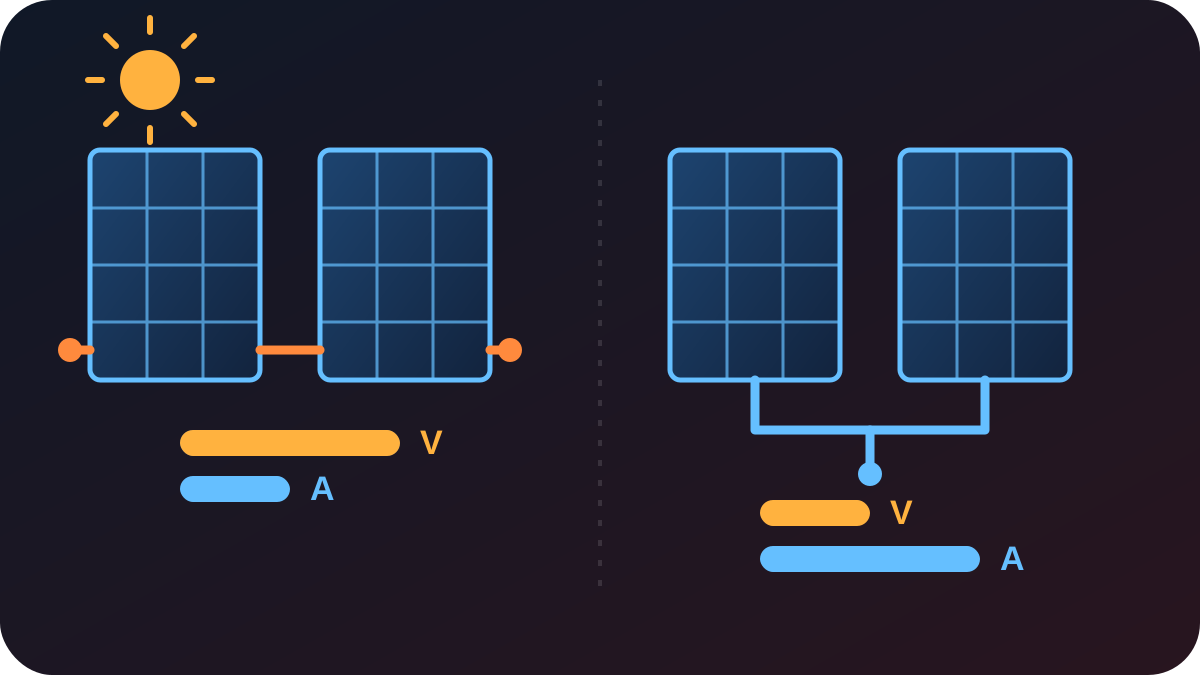
What does series or parallel wiring do?
Every solar panel has a plus lead and a minus lead. How you join them decides what the charger sees.
Series means end to end. The plus lead of one panel goes to the minus lead of the next. The voltages add up, while the current stays the same as one panel.
Parallel means side by side. A branch connector joins the plus leads together and the minus leads together. The currents add up, while the voltage stays the same as one panel.
The examples in this guide use a made-up 100 W panel, not a real product. Its open-circuit voltage (Voc) is 24 V, its working voltage (Vmp) is 20 V, its short-circuit current (Isc) is 5.3 A and its working current (Imp) is 5 A.
| Figure | Two in series | Two in parallel |
|---|---|---|
| Working voltage (Vmp) | 20 × 2 = 40 V | 20 V |
| Working current (Imp) | 5 A | 5 × 2 = 10 A |
| Open-circuit voltage (Voc) | 24 × 2 = 48 V | 24 V |
| Short-circuit current (Isc) | 5.3 A | 5.3 × 2 = 10.6 A |
Power is volts times amps. In series that is 40 × 5 = 200 W. In parallel it is 20 × 10 = 200 W. The panels make the same power either way.
Do solar panels charge faster in series or parallel?
On paper, neither. The same panels in the same sun make the same watts, so the battery fills at the same speed.
In real use, one way often charges faster than the other, for four reasons. The charger may not start at all with too little voltage. A long cable wastes more power at high current. Shade hurts a series string more. And some chargers cannot use extra voltage. The sections below take these one at a time, and each one points to a different choice.
So the honest answer is that the better wiring is the one that suits your charger, your cable and your roof. There is no single winner.
What limits does your charger set?
Every charger has a solar input with limits printed on its spec sheet. That charger might be a portable power station, or the charge controller in a van or cabin system. There are three limits to check.
- Maximum input voltage. The most voltage the input can take. Series raises the voltage, so it pushes toward this limit. Going over it can damage the charger.
- Start voltage. The least voltage the charger needs before it starts charging. Series helps here, because it raises the voltage.
- Maximum input current. The most current the input is built to carry. Parallel raises the current, so it pushes toward this limit.
That is the whole choice in short. Series runs into the voltage limit, while parallel runs into the current limit. The guide to solar input limits explains each limit in detail.
Why do cold mornings matter more in series?
Solar cells make more voltage when they are cold. The voltages on a panel's label are measured at 25 °C, so on a cold, bright morning the real voltage is higher than the label says.
In series, that extra voltage adds up panel by panel. A string that is safely under the limit at 25 °C can go over it on a frosty morning.
Solar Gear Scout's product pages check this for a -10 °C day, which is 14 °F. When a panel's maker publishes no temperature coefficient, the pages assume the voltage rises 0.40% for every degree below 25 °C, and they say so. For the made-up panel, that gives a cold Voc of 27.36 V.
Two of these panels in series reach 27.36 × 2 = 54.72 V on that cold morning. If your charger's limit is 50 V, that string is over it, even though the label voltages add up to only 48 V.
Parallel does not have this problem in the same way, because the voltage never adds. That is one reason parallel is the safer choice for a charger with a low voltage limit.
Does cable length change the answer?
Yes. A long cable run is one of the best reasons to choose series.
Some power is always lost as heat in the cable. That loss grows with the square of the current. Double the current and the loss in the same cable is four times as large.
Example A (illustrative): ten of the made-up panels make 1,000 W. Wired so the string runs at 100 V, the current is 1,000 ÷ 100 = 10 A. Wired all in parallel at 20 V, the current is 1,000 ÷ 20 = 50 A. That is 5 times the current, so the same cable would lose 5 × 5 = 25 times as much power.
To carry the higher current without that loss, you would need a much thicker cable, which costs more and is harder to route. Series keeps the current low, so a thinner cable can make the run.
For short runs, such as panels set out next to a power station, the difference is small. For a roof array with a long run down to the battery, it matters a lot.
What happens when part of the array is shaded?
Shade is the main reason to choose parallel.
In series, the same current flows through every panel. If one panel is shaded, it can pull down the current of the whole string. Most panels have bypass diodes that let current flow around the shaded part, which limits the loss, but the string still gives up some power.
In parallel, each panel sends its own current. A shaded panel makes less, while the panels in full sun keep working at full strength.
If a tree, a vent or a roof rack shades part of your array for part of the day, parallel usually copes better. If every panel gets the same sun all day, shade is not a reason to pick either way.
Does an MPPT or PWM charge controller change the answer?
It can change it completely, so check which type you have.
An MPPT controller converts the panels' voltage down to what the battery needs. It can turn a high-voltage, low-current string into the lower voltage and higher current the battery wants. That makes series a good match, as long as the string stays inside the controller's voltage limit. Portable power stations generally use MPPT controllers.
A PWM controller connects the panels more or less straight to the battery, so the panels work at about the battery's voltage. It cannot turn extra voltage into extra current. With a PWM controller, wire panels whose working voltage suits the battery in parallel, and follow the controller maker's guidance on panel voltage.
The examples below assume an MPPT controller, as in a portable power station.
Example: two panels on a portable power station
Example B (illustrative): a made-up power station accepts 12 to 50 V, up to 15 A and up to 400 W on one solar input. You have two of the made-up 100 W panels.
- In series: the cold-morning voltage is 54.72 V, over the 50 V limit. Series does not work here.
- In parallel: the voltage stays at one panel's level, and the current is 5.3 × 2 = 10.6 A, under the 15 A limit. Parallel works.
So for this station, parallel is the only safe choice. The two panels give up to 200 W, under the station's 400 W limit. The compatibility checker gives the same answer for these numbers.
Many portable power stations have a voltage limit of around 50 to 60 V, so series is often limited to two or three small panels. Check your own station's limit before you plan a string.
Example: a larger system with a charge controller
Example C (illustrative): a made-up MPPT charge controller for a van or cabin accepts up to 150 V and up to 30 A, starts charging at 30 V, and uses up to 1,000 W of solar. You have ten of the made-up panels.
- Most panels in series. Divide the maximum voltage by the cold Voc and round down. 150 ÷ 27.36 = 5.5, so 5 panels. Five panels reach 27.36 × 5 = 136.8 V on a cold morning, under 150 V. Six would reach 27.36 × 6 = 164.16 V, over the limit.
- Fewest panels in series. Divide the start voltage by Vmp and round up. 30 ÷ 20 = 1.5, so 2 panels. One panel alone never reaches the 30 V start.
- Most strings in parallel. Divide the current limit by one string's Isc and round down. 30 ÷ 5.3 = 5.7, so 5 strings.
Ten panels fit as two strings of five. Each string runs at 20 × 5 = 100 V. The two strings together carry 5.3 × 2 = 10.6 A at most, well under 30 A. The array is rated 100 × 10 = 1,000 W, right at the controller's limit.
Compare that with all ten in parallel. One panel cannot reach the 30 V start, so that would not charge at all, and it would need 50 A, far over the 30 A limit. In this system, series is the only way that works.
Can you combine series and parallel?
Yes, and larger arrays usually do. You build several series strings of the same length, then join the strings in parallel. Example C is one: two strings of five.
This is often written as "5S2P", meaning 5 in series and 2 in parallel. The voltage is set by the number in series, and the current by the number of strings.
A mix lets you stay inside both limits at once. Raise the string length until the cold voltage nears the voltage limit, then add strings until the current or the watts reach their limits.
Every string in parallel should have the same number of the same panels. A shorter string runs at a lower voltage and drags the others down.
Can you mix different solar panels?
It is possible, but you lose power, so it is best avoided.
- Different panels in series all carry the same current, so the string runs at about the current of the weakest panel. Panels with higher current are held back.
- Different panels in parallel all work at the same voltage, so the array runs near the voltage that suits the lower-voltage panels.
If you must mix, parallel is usually more forgiving with panels of similar voltage, and series with panels of similar current. Check both makers' guidance first. The math in this guide assumes identical panels.
What connectors and fuses do you need?
Most panels end in MC4 connectors, the usual plug for joining panels.
- Series needs no extra parts. The plus MC4 of one panel plugs into the minus MC4 of the next.
- Parallel needs branch connectors, often sold as MC4 Y connectors. One joins the plus leads, and one joins the minus leads.
- An adapter cable may be needed at the charger end, for example MC4 to XT60 for many power stations. Pick one rated for at least the current of the whole array.
Each panel's spec sheet lists a maximum series fuse rating. When several strings run in parallel, each string may need its own fuse, so that a fault in one string cannot push the current of the others back through it. Follow the panel and controller manuals on this.
Strings of several panels can reach voltages that are dangerous to touch. Plugging portable panels into a power station is a simple job. A roof array, or anything wired into a house, is a job for a licensed electrician.
How do you decide for your own setup?
| Your situation | Leans toward | Why |
|---|---|---|
| Low voltage limit (about 50 to 60 V) | Parallel | Series can go over the limit on a cold morning. |
| One panel is under the start voltage | Series | Adding voltage gets the charger started. |
| Long cable run | Series | Lower current wastes less power in the cable. |
| Part of the array gets shade | Parallel | A shaded panel does not hold back the others. |
| PWM charge controller | Parallel | PWM cannot use the extra voltage of a string. |
| Large array | Both | Strings in series, joined in parallel, fit both limits. |
The charger's limits always come first. A choice that breaks the voltage or current limit is not an option, however well it scores on cable or shade.
You can check a panel against a power station in the compatibility checker, which does the cold-voltage and current math for you.
Which solar panels are on sale now?
The table below is live: it is filled in each time this page loads. It lists the solar panels with the lowest cost per watt right now. When you plan a string, buy the same model for every panel in it.
| Product | Best current price | Cost per watt |
|---|---|---|
| Renogy 200W N-Type Solar Panel | $179.99 | $0.900/W |
| Renogy 100W N-Type Bifacial Solar Panel | $99.99 | $1.000/W |
| Renogy 200W N-Type Bifacial Solar Panel | $199.99 | $1.000/W |
| Renogy 250W N-Type Bifacial Solar Panel | $264.99 | $1.060/W |
| Renogy ShadowFlux 120W N-Type Anti-Shading Solar Panel | $129.99 | $1.083/W |
| Renogy 100W N-Type Solar Panel | $109.99 | $1.100/W |
| Renogy E.Flex 200W N-Type Portable Solar Panel | $219.99 | $1.100/W |
| Renogy 50W Mono N-Type Rigid Solar Panel | $55.99 | $1.120/W |
Each product page lists the panel's voltages and currents where the maker publishes them. You can browse every tracked panel on the solar panels page.
A series or parallel checklist.
- Find your charger's limits. Maximum voltage, start voltage and maximum current.
- Find your panel's figures. Voc, Vmp, Isc and the temperature coefficient of Voc.
- Work out the cold Voc. Use the coldest morning you expect.
- Find the most panels in series. Maximum voltage divided by cold Voc, rounded down.
- Find the fewest panels in series. Start voltage divided by Vmp, rounded up.
- Find the most strings in parallel. Maximum current divided by Isc, rounded down.
- Think about cable and shade. Long runs favor series. Partial shade favors parallel.
- Check the controller type. PWM favors parallel.
- Use identical panels. Same model in every string, same number in every string.
- Get the right parts. Branch connectors, adapter cable and fuses where the manuals call for them.
Common mistakes to avoid.
- Using label voltages for the limit. Use the cold-morning Voc. It is higher.
- Thinking series makes more power. It makes the same watts at a higher voltage.
- Putting too many panels in series on a power station. Many have a voltage limit of only around 50 to 60 V.
- Running a long cable at high current. The loss grows with the square of the current.
- Wiring a shaded array in one long string. One shaded panel can hold back the rest.
- Pairing series strings with a PWM controller. The extra voltage goes to waste.
- Mixing panel models in one string. The weakest panel sets the pace.
- Joining strings of different lengths. The shorter string drags the others down.
- Wiring a roof array yourself. Use a licensed electrician.
Related tools and pages.
- What a power station's solar input limits mean
- Compatibility checker
- Solar recharge estimator
- Solar panel price per watt
- Off-grid or hybrid inverter
- Solar panels
Series or parallel FAQ.
Is it better to wire solar panels in series or parallel?
It depends on your charger and your site. Series suits a high voltage limit and a long cable run. Parallel suits a low voltage limit, partial shade or a PWM controller. Large arrays usually combine both.
Do solar panels charge faster in series or parallel?
The same panels make the same watts either way. In practice the faster one is whichever avoids a problem: series if one panel cannot reach the start voltage or the cable is long, parallel if part of the array is shaded.
How many solar panels can I put in series?
Divide your charger's maximum input voltage by one panel's cold-morning open-circuit voltage, and round down. The compatibility checker does this for a panel and a power station.
Should two 100 W panels go in series or parallel on a power station?
Check the station's maximum input voltage against two panels' cold-morning voltage. On a station with a limit around 50 V, two panels of about 24 V Voc usually have to go in parallel.
Do I need a fuse for panels in parallel?
When several strings run in parallel, each string may need its own fuse, sized to the panel's maximum series fuse rating. Follow the panel and controller manuals.
This guide explains the checks made by Solar Gear Scout's compatibility checker, which uses only figures checked against each maker's own published documents. The cold-weather sum uses -10 °C and, when a panel's maker publishes no temperature coefficient, an assumed -0.40% per °C. Solar Gear Scout has not tested any solar panel, power station or charge controller.
The panels, the station and the charge controller in the examples are made up, with round numbers chosen to show the math. They are not real products. The only current product data on this page is in the live table, which is filled in from Solar Gear Scout's data each time the page loads. Read the manuals for your own panels and charger before you connect them. Where a manual differs from this guide, follow the manual.