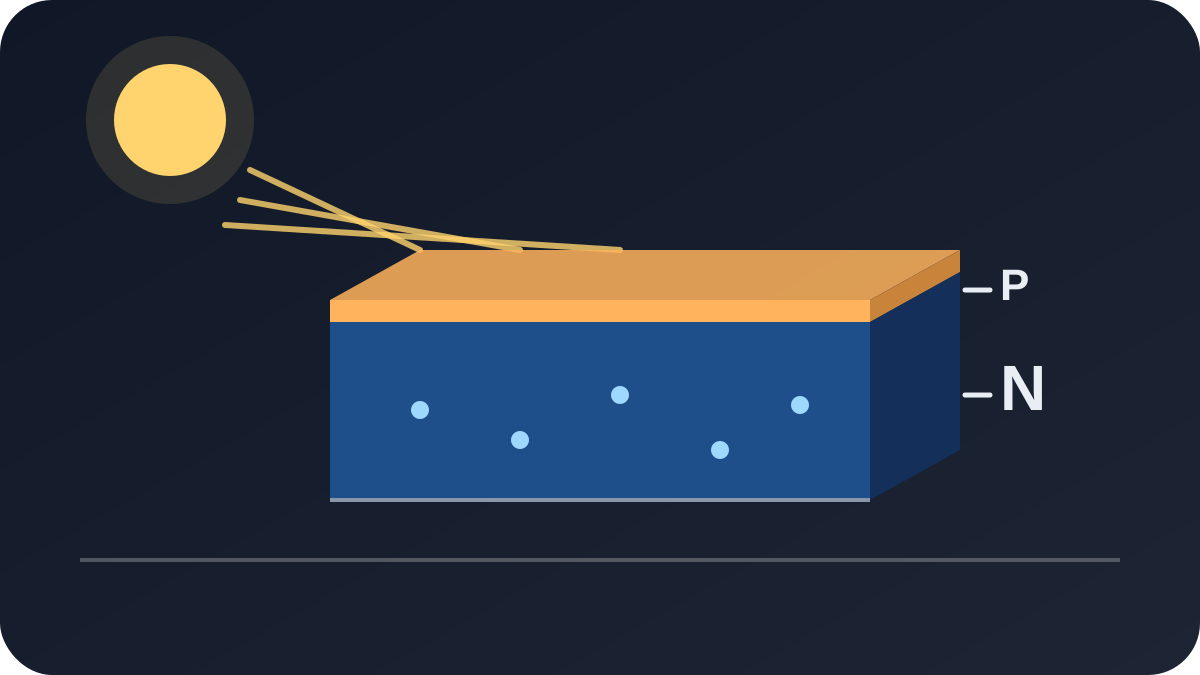
What do N-type and P-type mean?
They describe how the silicon is doped with another element.
- N-type silicon is doped with an element such as phosphorus, which has one more electron in its outer shell than silicon.
- P-type silicon is doped with an element such as boron, which has one less.
What is an N-type solar panel?
It is a panel whose cells are built on N-type silicon. In the classic silicon cell, the base is P-type silicon. In N-type diffused cells, boron is the dopant used to form the junction.
Are most solar cells now made on N-type silicon?
Yes, by the industry's own figures. The ITRPV says N-type material made up about 82% of the wafer market in 2025. Fraunhofer ISE's 2026 report, citing the ITRPV, gives N-type wafers an 86% share. The two figures differ, and the reports do not say why.
The ITRPV also says TOPCon's market share passed PERC's in 2024. The ITRPV says PERC had only around 14% of the market in 2025 and is expected to disappear over the next 10 years.
How does N-type module efficiency compare?
The ITRPV gives these figures. The N-type figures are what it says today's modules show; the PERC figure is its expected average for 2025.
| Cell design | Cell type | Module efficiency |
|---|---|---|
| TOPCon-based back contact (TBC) | N-type | 24.1% |
| TOPCon | N-type | 23.5% |
| Silicon heterojunction (SHJ) | N-type | 23.5% |
| PERC | P-type | 21.7% |
These are industry-wide figures, not the figure for any one panel, and single panels differ. Check each panel's own datasheet. The solar panel efficiency guide explains what the percentage means.
What do TOPCon, heterojunction and PERC mean?
They are names for cell designs:
- TOPCon stands for tunnel oxide passivated contact. It is an N-type design.
- Heterojunction, also written SHJ or HJT, is another N-type design.
- PERC is a P-type design. Fraunhofer ISE says N-type TOPCon and heterojunction replace it.
What do the N-type panel datasheets we hold say?
The two N-type 200 W panel datasheets we hold list module efficiencies of 19.9% and 20.7%. These are single panels, not industry-wide figures. One of the sheets says its N-type cells reach up to 25% conversion efficiency; that is a cell figure, and it lists 20.70% module efficiency for its 200 W panel.
Which N-type panels does Solar Gear Scout track?
The table below is live: it is filled in each time this page loads. It lists panels whose maker states N-type cells first, then other panels in order of cost per watt, with the module efficiency each maker states.
| Panel | Cell type (maker-stated) | Module efficiency | Best current price | Cost per watt |
|---|---|---|---|---|
| Renogy 200W N-Type Bifacial Solar Panel | N-type | 19.9% | $199.99 | $1.000/W |
| Renogy ShadowFlux 120W N-Type Anti-Shading Solar Panel | N-type | 20.7% | $129.99 | $1.083/W |
| Renogy 100W N-Type Bifacial Solar Panel | N-type | 20% | $111.99 | $1.120/W |
| Renogy ShadowFlux 200W N-Type Anti-Shading Solar Panel | N-type | 20.7% | $239.99 | $1.200/W |
| Renogy 200W N-Type Solar Panel | not stated | 20.7% | $179.99 | $0.900/W |
| BougeRV 50W Fiberglass Flexible Portable Solar Panel | not stated | not stated | $49.99 | $1.000/W |
| Renogy 250W N-Type Bifacial Solar Panel | not stated | 21.2% | $264.99 | $1.060/W |
| Renogy 100W N-Type Solar Panel | not stated | 20% | $109.99 | $1.100/W |
| Renogy E.Flex 200W N-Type Portable Solar Panel | not stated | not stated | $219.99 | $1.100/W |
| Renogy 50W Mono N-Type Rigid Solar Panel | not stated | 16.9% | $55.99 | $1.120/W |
You can browse every tracked panel on the solar panels page.
An N-type checklist.
- Find the cell type on the datasheet: N-type, P-type, or a design name such as TOPCon or PERC.
- Find the module efficiency, not the cell efficiency.
Related tools and pages.
N-type solar panel FAQ.
What is the difference between N-type and P-type solar panels?
The silicon in their cells. N-type silicon is doped with an element such as phosphorus; P-type with an element such as boron.
How does N-type efficiency compare with P-type?
In the ITRPV's figures, today's TOPCon and heterojunction modules show 23.5% efficiency, and it expects PERC modules to average 21.7% in 2025. Single panels differ.
Is TOPCon the same as N-type?
No. TOPCon is one N-type cell design; heterojunction is another.
Are P-type panels still made?
Yes, but PERC, a P-type design, is losing market share. The ITRPV says it had only around 14% of the market in 2025 and is expected to disappear over the next 10 years.
The general statements on this page rest on published sources, each quoted in our facts file: the International Technology Roadmap for Photovoltaics (ITRPV, 17th edition, June 2026); Fraunhofer ISE's Photovoltaics Report (July 2026); PVEducation, the online photovoltaics textbook by Christiana Honsberg and Stuart Bowden; the NEED Project's Solar At A Glance; and PV Tech's and PV Magazine's reports on the ITRPV. Statements about specific panels come from the makers' own datasheets, read and checked by Solar Gear Scout. Solar Gear Scout has not tested any solar panel.
Panel facts in the live table are filled in from Solar Gear Scout's data each time the page loads.