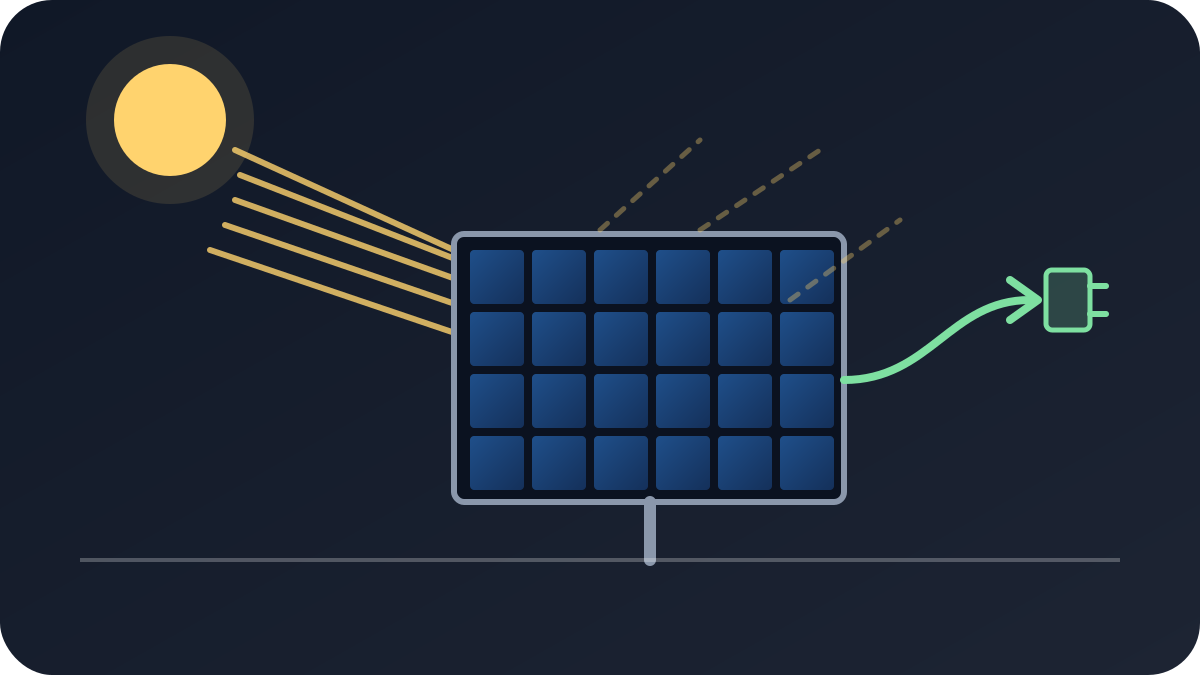
What does solar panel efficiency mean?
It is the share of the sunlight's energy shining on a panel that the panel turns into electricity. The rest does not become electricity.
So a panel that is 20% efficient turns about a fifth of the sunlight that hits it into power. A panel that is 15% efficient turns about 3 parts in 20 into power.
How is solar panel efficiency measured?
Under fixed test conditions, so every panel is measured the same way. The light is set to 1,000 watts per square meter, and the solar cells are held at 25 °C (77 °F). These are called standard test conditions, or STC.
The conditions are fixed because efficiency depends on the light and on the cell's temperature, not only on the panel. One panel datasheet we hold says its figures were tested under standard test conditions, with light at 1,000 W per square meter and a temperature of 25 °C.
Because every panel is measured under the same conditions, the efficiency lets you compare panels. Your panel will see other light levels and temperatures.
How do you calculate solar panel efficiency?
Divide the panel's rated watts by the light that falls on the area of its face at test conditions. At test conditions, each square meter gets 1,000 watts of light. So:
Efficiency = rated watts ÷ (panel area in square meters × 1,000)
Example (illustrative): a made-up 200 W panel measures 1.6 meters by 0.625 meters. Its area is 1.6 × 0.625 = 1 square meter, so at test conditions it gets 1 × 1,000 = 1,000 watts of light. It makes 200 watts, so its efficiency is 200 ÷ 1,000 = 0.2, which is 20%.
You can use this to check a figure on a datasheet.
What is the highest solar panel efficiency today?
The best commercial panels made from monocrystalline silicon wafers are now just under 25% efficient. Fraunhofer ISE's 2026 report says those commercial modules have risen from about 17% to just under 25% over the past decade. The U.S. Energy Information Administration says state-of-the-art modules are approaching 25%.
The panel datasheets we hold list module efficiencies from 15.0% to 21.2%. In those sheets, the flexible panels that list a module efficiency show 15.0% and 16.7%, and the rigid glass panels list 16.9% to 21.2%.
What is the difference between cell efficiency and module efficiency?
Cell efficiency is for one solar cell. Module efficiency is for the whole panel, and it is the lower of the two. The record numbers show the gap: Fraunhofer ISE lists a record silicon cell at 28.1% and a record silicon module at 26.0%. Research at Purdue University describes a gap between cell and module efficiency.
A panel's layout matters too. How much of the panel's face is covered by cells rather than blank space affects its output.
One datasheet we hold says its cells have up to 25% conversion efficiency, while the same sheet lists 20.70% module efficiency for its 200 W panel. When you compare panels, compare module efficiency with module efficiency.
Does a more efficient panel make more power?
Not more than its watt rating. A 200 W panel is rated at 200 W whatever its efficiency. The difference is size: a more efficient panel makes the same watts from less area.
Example (illustrative): a made-up 200 W panel that is 22% efficient needs about 200 ÷ 0.22 ÷ 1,000 = 0.91 square meters. A made-up 200 W panel that is 18% efficient needs about 200 ÷ 0.18 ÷ 1,000 = 1.11 square meters. Both are 200 W panels; the first is smaller.
| Your situation | What to compare first |
|---|---|
| Small space, such as a van or RV roof or a small balcony | Efficiency: a more efficient panel fits more watts in the same area |
| Plenty of space, such as a yard or a large roof | Cost per watt: the area saved matters less |
Cost per watt is the price divided by the panel's rated watts. The price per watt guide explains it.
Does heat lower solar panel efficiency?
Yes. Solar cells generally work best when they are cool. As they heat up, their voltage drops much more than their current rises, so the panel makes less power. For silicon cells, one textbook source puts the loss at 0.4% to 0.5% of power for each degree Celsius.
Datasheets list this as the temperature coefficient of Pmax. The datasheets we hold list, for example, -0.32% per °C and -0.42% per °C. A number closer to zero means the panel loses less power as it heats up.
Example (illustrative): a made-up 200 W panel loses 0.4% per °C. On a hot day its cells reach 45 °C, which is 20 degrees above the 25 °C test temperature. It loses about 20 × 0.4 = 8%, so it makes about 200 × 0.92 = 184 W in full sun.
Does solar panel output drop over time?
Yes, slowly. An NREL review of nearly 2,000 rates measured on single panels or whole systems found a median loss of 0.5% a year. PV Magazine reports that NREL's 2024 study of U.S. solar systems found a median performance loss of 0.75% a year.
Example (illustrative, simple estimate): at about 0.5% a year, a panel loses about 0.5 × 10 = 5% over 10 years. A made-up 200 W panel would then make about 200 × 0.95 = 190 W at test conditions.
What about record-breaking efficiencies in the news?
Those are lab and special-use cells, far above the panels sold for everyday use. Experimental cells and cells for uses such as space satellites have reached nearly 50%. Fraunhofer ISE lists lab cells that stack several layers and work under concentrated sunlight at up to 47.6%. The best everyday silicon panels are just under 25%.
Which panels does Solar Gear Scout track, and how efficient are they?
The table below is live: it is filled in each time this page loads. It lists panels whose maker states a module efficiency first, highest first, then best-value panels whose maker does not. Only a module figure from the maker's own document is shown; a cell figure or an "up to" figure is not.
| Panel | Rated power | Module efficiency | Weight | Best current price | Cost per watt |
|---|---|---|---|---|---|
| Renogy 250W N-Type Bifacial Solar Panel | 250 W | 21.2% | 27.3 lb | $264.99 | $1.060/W |
| Renogy 200W N-Type Solar Panel | 200 W | 20.7% | 23.4 lb | $179.99 | $0.900/W |
| Renogy ShadowFlux 120W N-Type Anti-Shading Solar Panel | 120 W | 20.7% | 15.9 lb | $129.99 | $1.083/W |
| Renogy ShadowFlux 200W N-Type Anti-Shading Solar Panel | 200 W | 20.7% | 23.8 lb | $239.99 | $1.200/W |
| Renogy 100W N-Type Solar Panel | 100 W | 20% | 13 lb | $109.99 | $1.100/W |
| Renogy 100W N-Type Bifacial Solar Panel | 100 W | 20% | 12 lb | $111.99 | $1.120/W |
| Renogy 200W N-Type Bifacial Solar Panel | 200 W | 19.9% | 22.7 lb | $199.99 | $1.000/W |
| Renogy 50W Mono N-Type Rigid Solar Panel | 50 W | 16.9% | 7.7 lb | $55.99 | $1.120/W |
| Renogy 200 Watt 12 Volt Flexible Monocrystalline Solar Panel | 200 W | 16.7% | 10.8 lb | $311.99 | $1.560/W |
| Renogy 100W Lightweight Flexible Solar Panel (Black Division) | 100 W | 15.7% | 5.3 lb | $139.99 | $1.400/W |
You can browse every tracked panel on the solar panels page.
A solar panel efficiency checklist.
- Find the module efficiency on the datasheet, not the cell efficiency.
- Measure your space. If it is tight, a more efficient panel fits more watts.
- Check the temperature coefficient of Pmax. Closer to zero loses less power in heat.
- Compare cost per watt when space is not a problem.
Common mistakes to avoid.
- Comparing a cell figure with a module figure. The module figure is lower, so compare module with module.
- Expecting more watts from a more efficient panel. A 200 W panel is a 200 W panel; efficiency changes its size.
- Expecting the rated watts on a hot day. Heat lowers output.
- Comparing efficiency alone. Efficiency tells you about size, not price; cost per watt tells you about price.
Related tools and pages.
- Solar panel price per watt
- What is a bifacial solar panel?
- Solar panels in series or parallel
- What a power station's solar input limits mean
- Solar recharge estimator
- Solar panels
Solar panel efficiency FAQ.
What is the highest efficiency solar panel?
The best commercial panels made from monocrystalline silicon wafers are now just under 25% efficient. Lab records are higher, but those cells are not panels sold for everyday use. The live table above shows the module efficiency makers state for the panels we track.
Where does a 20% efficient solar panel sit?
A 20% module efficiency sits inside the 16.9% to 21.2% range the rigid glass panel datasheets we hold list. The flexible panels in those sheets list 15.0% and 16.7%.
Do high-efficiency solar panels make more power?
Not more than their watt rating. A more efficient panel makes the same watts from less area.
How do I calculate solar panel efficiency?
Divide the rated watts by the panel area in square meters times 1,000. A 200 W panel with 1 square meter of area is 20% efficient.
Does solar panel output go down over time?
Yes, slowly. Studies of panels and solar systems found median losses of about 0.5% to 0.75% a year.
Do flexible solar panels list lower efficiency?
In the datasheets we hold, the flexible panels list lower module efficiency (15.0% and 16.7%) than the rigid glass panels (16.9% to 21.2%). Each maker's datasheet gives its own figure; compare the module efficiency on each sheet.
The general statements on this page rest on published sources, each quoted in our facts file: the U.S. Department of Energy's Solar Energy Technologies Office; the U.S. Energy Information Administration; PVEducation, the online photovoltaics textbook by Christiana Honsberg and Stuart Bowden; Fraunhofer ISE's Photovoltaics Report (July 2026); an NREL review of degradation rates; a Purdue University paper; and PV Magazine's report on NREL's 2024 study of U.S. solar systems. Statements about specific panels come from the makers' own datasheets, read and checked by Solar Gear Scout. Solar Gear Scout has not tested any solar panel.
The panels and the numbers in the examples are made up, with round numbers chosen to show the math. They are not real products. Panel facts on this page come from makers' datasheets and from the live table, which is filled in from Solar Gear Scout's data each time the page loads. Where your own panel's datasheet differs from this guide, follow the datasheet.