What is a bifacial solar panel?
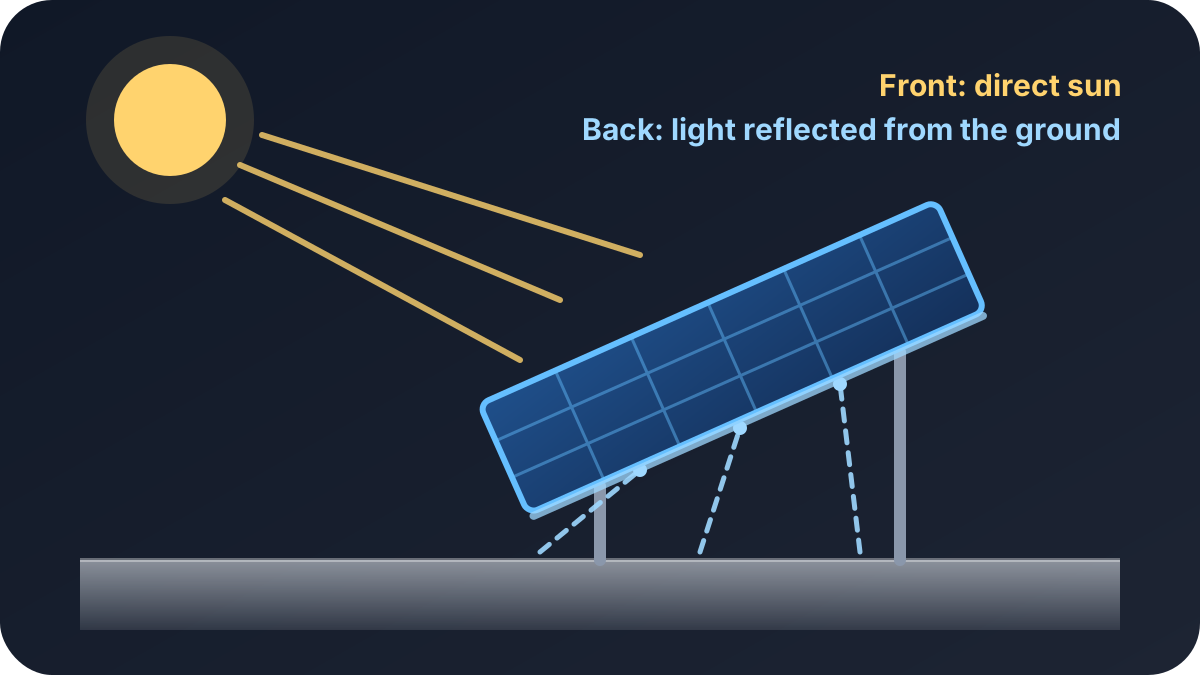
It is a solar panel whose cells can take in light from both sides. On a standard panel, called monofacial, the back blocks light from reaching the cells. A bifacial panel lets light reach the cells from the rear side too, so the same panel can make more power.
Over ordinary ground, the back usually adds under 10%, so the front still makes most of the power. How much the back adds depends on where and how you mount the panel.
How does the back side make power?
Sunlight hits the ground or a roof around the panel, and some of it bounces back up. The back of a bifacial panel catches part of that reflected light, plus some light from the open sky.
That light is uneven. Research groups have found that the light on the rear side is much less even than on the front. In one NREL study of a panel over a highly reflective roof, the back got more light near its bottom edge, less toward the middle.
How much extra power does a bifacial panel make?
Over ordinary ground, usually under 10%. Two research sources agree on the main points:
- Over ordinary ground, such as grass or soil, the extra energy from the back side is usually under 10%.
- Over a bright surface, the gain rises. In one study, white concrete roughly doubled it to about 20%, and raising the panel about 1 meter (3 feet) brought it to about 30%. Snow also raises the gain a lot while it covers the ground.
One maker's datasheet we hold says its 100 W and 200 W bifacial panels can make up to 30% more energy in environments like sand, snow or light-colored surfaces. Read "up to" as the best case, not what you will see everywhere.
Example (illustrative): a made-up 200 W panel gets about 5 hours of full sun a day, so its front makes about 200 × 5 = 1,000 Wh a day. With a 5% gain from the back over grass, that adds 1,000 × 0.05 = 50 Wh. Raised over a white surface with a 20% gain, it adds 1,000 × 0.2 = 200 Wh.
So the same panel can add a little or a lot. The surface under it and its height decide which.
What does the ground under the panel do?
It is one of the biggest factors. How much light a surface reflects is called its albedo, from 0 (reflects nothing) to 1 (reflects everything). The more the surface reflects, the more light reaches the back of the panel.
| Surface | Albedo | Share of light reflected |
|---|---|---|
| Grass or light soil | About 0.2 (grass 0.15 to 0.25, light soil 0.21) | About a fifth |
| Fresh snow or white roofing | About 0.8 (fresh snow 0.82, white roofing 0.81) | About four fifths |
That is why bifacial panels gain more over snow or white surfaces than over grass or soil. Darker ground reflects less, so the back gets less light.
Why does height above the ground matter?
Raising the panel lets more light reach its back. A panel shades the ground right under it, and when it sits close to the ground, research found its back gets less light because of that shadow. Raising it lets more light from the ground and sky reach the back. Research at Sandia National Laboratories found bifacial gains increase as the panel is raised.
Two more things help:
- Space between rows. The gain rises with the spacing between rows.
- Being at the edge. Panels at the end of a row get extra light, because fewer panels nearby shade the ground. In one study over light soil, a panel in the middle of a large array made up to 7% less energy than a single bifacial panel on its own.
What changes how much the back side adds?
| Factor | What research found |
|---|---|
| A bright surface under the panel | The gain rises with the surface's reflectivity. Snow raises it a lot; in one study white concrete roughly doubled it to about 20%. |
| Ordinary ground (grass or soil) | Usually under 10% extra energy. |
| Height above the surface | The gain rises as the panel is raised. In one study, 1 meter over a bright surface brought it to about 30%. |
| Close to a roof or the ground | The panel shades the surface under it, so its back gets less light. |
| Space around the panel | The gain rises with row spacing, and panels at the edge of a row get extra light. |
What is bifaciality?
Bifaciality is the ratio between how well the back of the panel turns light into power and how well the front does. A bifaciality of 90% means that, given the same light, the back makes 90% as much power as the front.
It tells you how well the back converts light, not how much light will reach it; that still depends on the surface below and the height.
Does the back side change the current a panel sends?
It can. Light on the back raises the panel's output current, the amps it sends, compared with a single-sided panel. An IEA report says bifacial arrays run at higher current, so system designers may need to adjust their wire, fuse and inverter sizing.
Example (illustrative, just the arithmetic): if a made-up panel rated for 10 A sent 20% more current, it would send 10 × 1.2 = 12 A.
Whatever panel you use, read your power station's or charge controller's solar input limits in its manual before you connect it. The solar input limits guide shows how to read those limits.
Bifacial vs monofacial: which should you buy?
It depends on where the panel will go. The back side adds more when the panel is raised, with a bright surface such as snow or white roofing under it, and with space around it. Mounted close to a surface, or over ordinary ground, the extra is smaller: usually under 10% over ordinary ground.
Bifacial is not the opposite of monocrystalline. "Monocrystalline" describes the cells; "bifacial" describes whether both sides make power. The two bifacial panel datasheets we hold list monocrystalline cells, and one lists N-type cells.
Whichever you choose, compare price fairly with cost per watt: the price divided by the panel's rated watts. The price per watt guide explains it.
Which bifacial panels does Solar Gear Scout track?
The table below is live: it is filled in each time this page loads. It shows the bifacial panels Solar Gear Scout tracks, then the best-value single-sided panels for comparison, with what each maker states about the panel type and cells.
| Panel | Sides that make power | Cell type | Weight | Best current price | Cost per watt |
|---|---|---|---|---|---|
| Renogy 200W N-Type Bifacial Solar Panel | Bifacial | N-type | 22.7 lb | $199.99 | $1.000/W |
| Renogy 250W N-Type Bifacial Solar Panel | Bifacial | not stated | 27.3 lb | $264.99 | $1.060/W |
| Renogy 100W N-Type Bifacial Solar Panel | Bifacial | N-type | 12 lb | $111.99 | $1.120/W |
| Renogy 200W N-Type Solar Panel | not stated | not stated | 23.4 lb | $179.99 | $0.900/W |
| BougeRV 50W Fiberglass Flexible Portable Solar Panel | not stated | not stated | not stated | $49.99 | $1.000/W |
| Renogy ShadowFlux 120W N-Type Anti-Shading Solar Panel | not stated | N-type | 15.9 lb | $129.99 | $1.083/W |
| Renogy 100W N-Type Solar Panel | not stated | not stated | 13 lb | $109.99 | $1.100/W |
| Renogy E.Flex 200W N-Type Portable Solar Panel | not stated | not stated | 14.8 lb | $219.99 | $1.100/W |
You can browse every tracked panel on the solar panels page.
A bifacial panel checklist.
- Look at what is under the panel. Snow and white surfaces reflect about four fifths of the light; grass and soil about a fifth.
- Plan the height. The gain rises as the panel is raised.
- Leave space around it. Wider row spacing and open edges raise the gain.
- Read your equipment's solar input limits in its manual before you connect any panel.
- Compare cost per watt with a single-sided panel.
Common mistakes to avoid.
- Expecting the "up to" figure everywhere. Over ordinary ground, the gain is usually under 10%.
- Mounting it close to a surface and expecting a big boost from the back. The panel shades the surface under it.
- Not planning for the extra current. Bifacial arrays can run at higher current than single-sided ones.
Related tools and pages.
- What a power station's solar input limits mean
- Solar panels in series or parallel
- Solar panel price per watt
- Solar recharge estimator
- Solar panels
Bifacial solar panel FAQ.
Are bifacial solar panels worth it?
It depends on what is under the panel and how high it sits. Over ordinary ground, the extra energy is usually under 10%. Over snow or a bright white surface, with the panel raised, it can be much more. Compare cost per watt with a single-sided panel.
Does it matter if a bifacial panel is mounted close to a roof?
Yes, for the back side. A bifacial panel makes power from the front like any panel. The back adds energy only when light reaches it. Mounted close to a roof, the panel shades the surface under it, so the back gets less light. A higher mount over a bright surface helps.
How much more power does a bifacial panel make?
It depends on the surface and the height. Over ordinary ground, usually under 10% more energy. In one study, white concrete raised it to about 20%, and raising the panel 1 meter brought it to about 30%.
What is the difference between bifacial and monofacial panels?
A monofacial panel makes power only from the front. A bifacial panel also makes power from light that reaches its back.
Is a bifacial panel the same as a monocrystalline panel?
No. Monocrystalline describes the type of cell; bifacial describes whether both sides make power. Check the datasheet for the cell type.
The general statements on this page rest on published sources, each quoted in our facts file: the International Energy Agency's PVPS Task 13 report on bifacial photovoltaic modules and systems (2021); research papers by Sandia National Laboratories, the National Renewable Energy Laboratory (NREL), the University of Iowa and Purdue University; Sandia's PV Performance Modeling Collaborative; and an engineering article in PV Tech. Statements about specific panels come from the makers' own datasheets, read and checked by Solar Gear Scout. Solar Gear Scout has not tested any solar panel.
The panels and the numbers in the examples are made up, with round numbers chosen to show the math. They are not real products. Panel facts on this page come from makers' datasheets and from the live table, which is filled in from Solar Gear Scout's data each time the page loads. Where your own panel's datasheet differs from this guide, follow the datasheet.