Which panel in this roundup is the best value?
The Renogy 100W N-Type Solar Panel is the best value in this roundup, ranked #1 of 3. It comes to $1.100/W, against $1.400/W for the Renogy 100W Lightweight Flexible Solar Panel (Black Division) and $1.990/W for the EcoFlow 100W Flexible Solar Panel. Its price at Renogy is $109.99.
Price per watt puts panels with different ratings on the same scale. All of these panels carry the same 100 W rating. When the rating is the same, the gap in value comes down to price.
The flexible Renogy panel ranks #2 of 3, and the EcoFlow panel ranks #3 of 3.
| Product | Best current price | Cost per watt | Value rank |
|---|---|---|---|
| Renogy 100W N-Type Solar Panel | $109.99 at Renogy | $1.100/W | #1 of 3 |
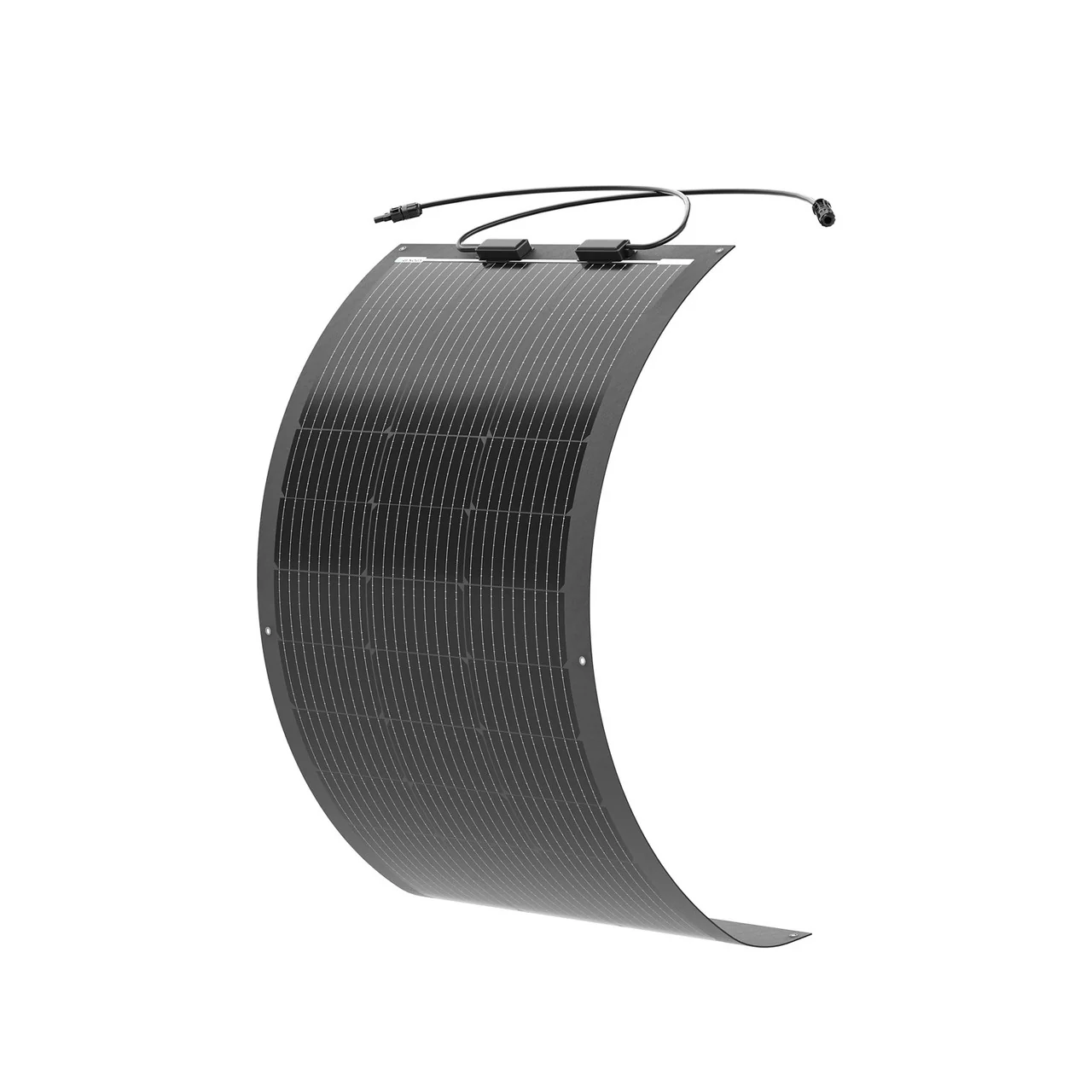 Renogy 100W Lightweight Flexible Solar Panel (Black Division) | $139.99 at Renogy | $1.400/W | #2 of 3 |
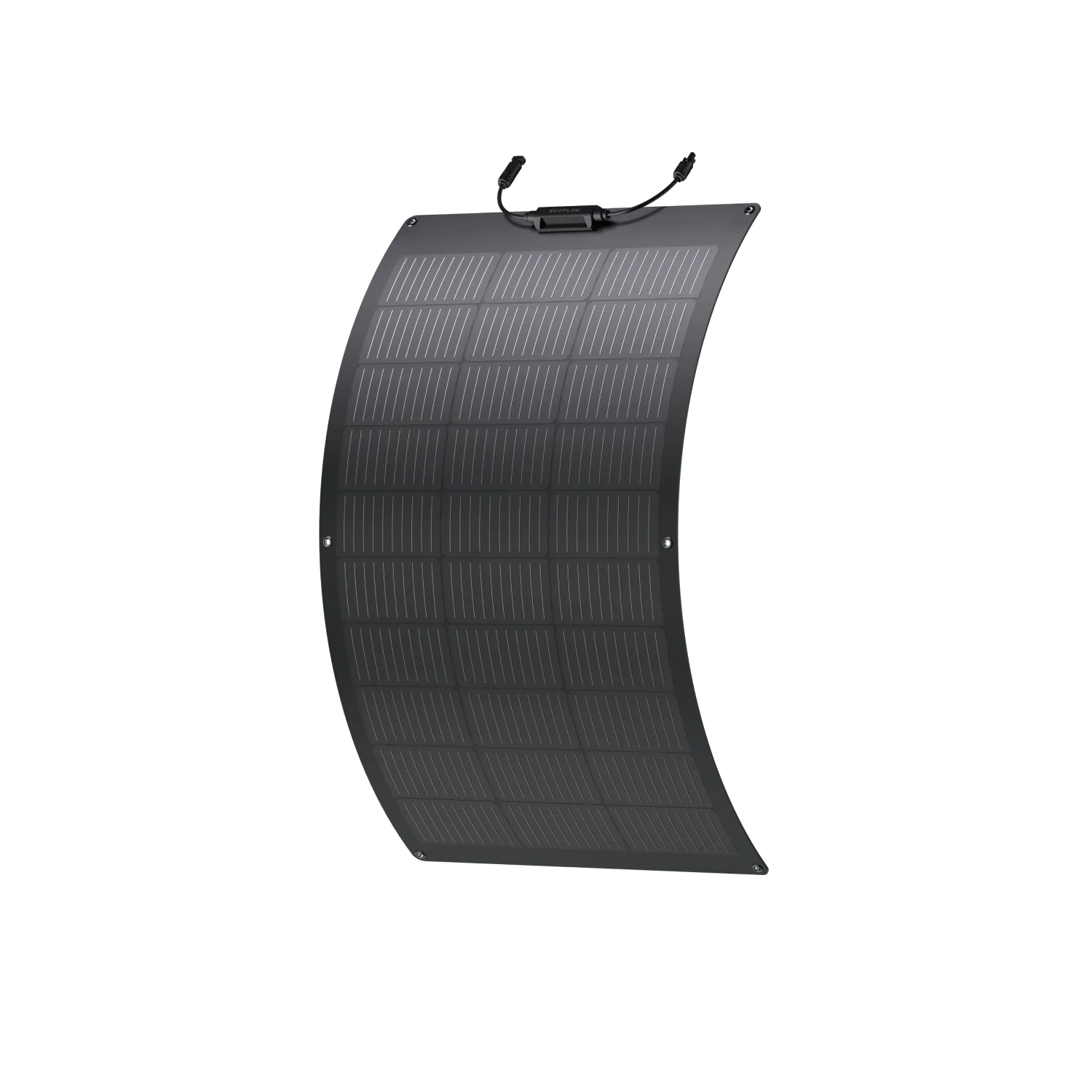 EcoFlow 100W Flexible Solar Panel | $149.00 at EcoFlow | $1.990/W | #3 of 3 |
What do you get with the Renogy 100W N-Type Solar Panel?
You get a panel rated at 100 W, and for the 100W N-Type Solar Panel Renogy lists an open-circuit voltage of 22.79 V and a short-circuit current of 5.31 A. At its maximum power point, Renogy rates the panel at 5.01 A. Renogy also lists a voltage temperature coefficient of -0.26 %/°C.
This figure shows how much voltage shifts for each degree of temperature change. A figure closer to zero means the voltage moves less with the weather. At $109.99 from Renogy, it has the lowest price in this group, below $139.99 for the Black Division panel and $199.00 for the EcoFlow panel.
That comes to $1.10 per watt at Renogy.
Where does the Renogy Black Division flexible panel fit?
The Renogy 100W Lightweight Flexible Solar Panel (Black Division) sits in the middle on value at $1.400/W, ranked #2 of 3. At Renogy it costs $139.99, or $1.40 per watt, which sits between $1.10 per watt for the N-Type panel and $1.99 per watt for the EcoFlow panel. Renogy rates it at 19.4 V and 5.2 A at the maximum power point.
That 19.4 V figure is higher than the 17.1 V that EcoFlow lists at the maximum power point for its flexible panel. Renogy lists 23.5 V open-circuit and 5.51 A short-circuit for this panel, both higher than the 22.79 V and 5.31 A it lists for the N-Type panel. Check whether your controller or power station lists a current limit.
Higher is not better on its own. What counts is that the figures stay inside the limits of the gear you plug into. If a listing leaves out a figure you need, ask the seller before you order.
What sets the EcoFlow 100W Flexible Solar Panel apart?
EcoFlow lists a warranty of 3 years for the 100W Flexible Solar Panel. At EcoFlow the panel is listed at $199.00, which comes to $1.99 per watt. On value that lands at $1.990/W, ranked #3 of 3.
At the maximum power point, EcoFlow lists 5.9 A at 17.1 V. According to EcoFlow, its open-circuit voltage is 20.3 V and its short-circuit current is 6.3 A. Its 20.3 V open-circuit voltage is the lowest here, below 22.79 V for the N-Type panel and 23.5 V for the Black Division panel.
That 6.3 A short-circuit figure is the highest here, above 5.51 A for the Black Division panel and 5.31 A for the N-Type panel. EcoFlow puts its voltage temperature coefficient at -0.33 %/°C, against -0.26 %/°C for the Renogy N-Type panel.
Which specs should you line up across these panels?
Open-circuit voltage and short-circuit current must stay inside the input limits of your gear. Look up the solar input limits of your gear first. The open-circuit figures are 22.79 V for the N-Type panel, 23.5 V for the Black Division panel and 20.3 V for the EcoFlow panel.
For short-circuit current, the N-Type panel is listed at 5.31 A, the Black Division panel at 5.51 A and the EcoFlow panel at 6.3 A. Current at the maximum power point is 5.01 A on the N-Type panel, 5.2 A on the Black Division panel and 5.9 A on the EcoFlow panel. Wiring panels in series adds their voltages.
Wiring them in parallel adds their currents. Keep the total inside your gear's limit. Voltage rises as cells get colder, so the open-circuit figure is the one to check when you size a setup for cold weather.
On that point, the temperature coefficient is -0.26 %/°C for the N-Type panel and -0.33 %/°C for the EcoFlow panel.
How should you choose between these panels?
Choose the Renogy 100W N-Type Solar Panel if value comes first: it is ranked #1 of 3 at $109.99. The Renogy 100W Lightweight Flexible Solar Panel (Black Division) comes next on value, ranked #2 of 3 at $139.99. The EcoFlow 100W Flexible Solar Panel is ranked #3 of 3 at $199.00.
EcoFlow lists a warranty of 3 years for it. A panel that fits your gear is the one to compare on price per watt.